
ARCHIVE FILE
See the original document
INSTITUTE OF INSPECTORS OF STOCK OF N.S.W. YEAR BOOK.
A Peculiar Condition in Jersey Calves
E. A. LUCAS, Inspector of Stock, Maitland.
The condition here described is completely new in the writer's 35 years' experience among cattle; and in 16 years in this particular District. So far as is known it has not been reported elsewhere, nor has the etiology been determined with any degree of certainty; though an apparently effective treatment has been demonstrated.
From the history available, the condition first appeared early in 1948 on a single farm towards the northern end of this District. Two or three cases occurred then; and on a re-appearance some 12 months later the occurrence was reported, and investigated with the D.V.O., Central. Of ten well bred heifer calves about six months old, three had been affected and one had died.
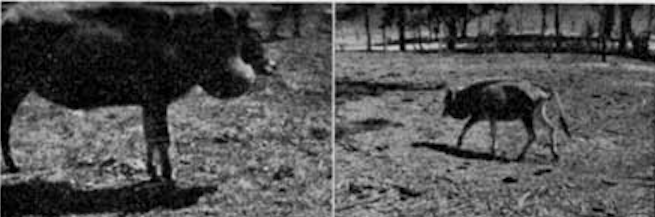
The very obvious lesion was confined to the pharangeal area and consisted of a large, quite solid and perfectly round swelling about 7 inches in diameter. In the case which was killed for post-mortem examination the swelling was so large that the heifer actually had great difficulty in "reaching over it" to feed from the ground. The accompanying photographs describe the condition much more easily, however, than one can in words!
On post-mortem. which was carried out by the D.V.O., the swelling were found to be uniformly solid, and apparently fibrous, material containing numerous small areas which were somewhat similar to those seen in many lesions of Actinomycosis; but there was not any pus formation. Pipettes and smears,together with one-half of the lesion itself, were forwarded to Glenfield for examination.
The Director of Veterinary Research subsequently advised that examination of the material failed to reveal any typical club colonies resembling Actinomyces; but that on culture heavy growths of a small, gram-negative organism were isolated.
The remaining affected calf was treated by the writer with Sulphapyridine. The initial dose consisted of 1 gramme per 15 lbs. live weight; while subsequent doses of half this quantity were given twice daily for four days. Recovery was rapid and complete; the swelling, almost as large as the one examined on post-mortem, disappearing in about 14 days.
Acknowledgment
The photographs published with this article were taken by Mr. R. Hall, B.V.Sc. (D.V.O. Central), whose action in supplying them is appreciated.