
ARCHIVE FILE
See the original document
INSTITUTE OF INSPECTORS OF STOCK OF N.S.W. YEAR BOOK.
Artificial Insemination and Infertility in Cattle
R. W. HEWETSON, B.V.Sc., A.I. Centre, Berry
ARTIFICIAL INSEMINATION
The technique of artificial insemination is not new, but it is only since 1942, with improvements in technique, that its commercial usage has been exploited in European and English-speaking countries.
In 1952 there were only 5 centres in England, with a stud of 50 bulls. To-day there are over 30 main centres, using 630 bulls and inseminating 49 per cent. (1,083,000) of the cattle of England. Similarly the widespread use of A.I. has developed in Denmark, where 70 per cent of the cattle are inseminated, and in Sweden where 50 per cent of the cattle are so treated. Two million cows, or 15 per cent., of the total dairy cattle of the United States are bred by A.I.
The use of A.I. has been more recent in New Zealand, where from a humble beginnings of 800 cows inseminated in 1943, and in the face of technical difficulties, A.I. has progressed to the stage where, in 1953, 35,000 cows were inseminated.
The initial reason for the commercial use of A.I. is rapidly to improve the productive ability of a large cattle population by the use of high-grade, and sometimes proven, bulls for herds which are unable, for a variety of reasons, to select and purchase such bulls. Most farmers who use A.I. do so in the hope that this will lead to more rapid improvements in the production of their cattle, but often a smaller number are forced by the onset of herd infertility to apply this technique in order to control the spread of genital disease, and to replace the use of infertile and diseased bulls by a hygienic source of healthy viable semen.
SELECTION OF SIRES FOR ARTIFICIAL BREEDING
A.I. in Australia always will be relatively expensive because of the higher salaries paid and the higher mileage costs per cow. For this reason we must make the greatest use of bulls which we are sure will improve our national dairy herd.
Rendell (1954) states that the widespread use of A.I. in England has shown that this system of breeding, to date, has put at the disposal of the breeder and the general farmer bulls whose merit is just about the same as the merit of the bulls he has been using: the advantage of the disease free, relatively speaking, is less trouble and is cheaper than keeping a bull.
During the last few years Dr. Robertson, of Edinburgh, has compared the records of A.I. daughters sired by bulls in a number of private centres with the production of daughters in the same herds sired by non-A.I. bulls. The average production improvement by the A.I. bulls of the three main breeds over the non-A.I. bulls on 1500 lactations was one gallon!
This is more or less what would be expected, since it is impossible to foretell what a bull's merit is until he has been used, and no breeding methods in common use to-day are calculated to increase the production of dairy stock at any appreciable rate.
No stud breeder could afford to mate his unknown young bulls to enough cows to produce a minimum number of 25 daughters and it is not until a minimum of 25 daughters have been recorded that one has any idea of the bull's worth.
It is obvious from present knowledge that the average of the first 10 daughters' production is quite misleading when compared with the average production of the first 50 daughters, and it is not until the production of the first 25 daughters is taken that the variation begins to be reduced to more reasonable proportions.
New Zealand is somewhat more fortunate than other countries in that 75 per cent of the national dairy herd are of one breed and a larger proportion of these are herd recorded (20 per cent.).
Of 3,000 bulls surveyed every year only a very small number can be selected for use with A.I. In fact, even with these large numbers of bulls under progeny test, Hancock (1952) claims that the great scarcity of bulls available for A.I. of a type able to raise his daughters' production by 30 lbs. or more of butterfat, will limit the use of A.I. to herds of commercial cattle. To alleviate this shortage, sons of proven bulls will be tested in their centres.
NEW ZEALAND RESULTS FOR 1951-52
| Herd No. | Hand Bred Heifers LBS. B.F. | A.I. Bred Heifers LBS. B.F. | Diff. |
|---|---|---|---|
| 1 | 354 | 349 | Minus 5 |
| 2 | 329 | 367 | Plus 38 |
| 3 | 250 | 271 | Plus 21 |
| 4 | 283 | 313 | Plus 30 |
| 5 | 266 | 308 | Plus 42 |
| 6 | 265 | 296 | Plus 31 |
| 7 | 266 | 321 | Plus 55 |
| 8 | 231 | 297 | Plus 66 |
1953
| No. Herds | No. of Daughters | Av. Fat Expected | Average | Diff. | |
|---|---|---|---|---|---|
| Average of top 1/3rd of herds 339-435 lbs. B.F. |
15 | 275 | 367 (366) | 356 | plus 11 |
| Average middle 1/3rd 312-338 lbs. B.F |
14 | 135 | 353 (329) | 325 | plus 28 |
| Average bottom 1/3rd 251-310 lbs. B.F. |
15 | 352 | 312 (285) | 287 | plus 25 |
| ( ) mature cow average | |||||
Wherever A.I. has been initiated, rapid expansion accentuates the lack of proven bulls which stay proven in A.I. centres.
Rendell states that if A.I. is to increase the potential yielding capacity of the dairy population, the centres must be used not only for dissemination from highly priced bulls, but also for breeding bulls of high merit. Since our A.I. centre serves a large population, and can compare one bull with another on the performance of daughters reared in the same or similar herds, it has a unique opportunity for constructive dairy cattle breeding. Sires selected for artificial breeding not only must be above average transmitters of genes for high production, but also must be disease tree.
It has been suggested that resistance to mastitis and to bloat also is inherited and no doubt these factors should be borne in mind when sires are selected.
Frozen semen opens up vast potentials since every single dose can be utilised. It will mean a reduction in the numbers of bulls used for A.I. and here lies a considerable danger which must be watched closely. There is no doubt that our knowledge of inheritance must be increased greatly before we can make maximum use of this new technique.
In most cases in Australia official testing is done only on selected daughters under above-average nutritional conditions. If we are to locate proven sires it would appear that we will have to breed and prove these bulls in our own A.I. centres.
SOME TECHNICAL ASPECTS OF A.I.
Since it is necessary that a constant supply of diluted semen not more than three days, and at the most four days, old must be on hand, the regular collection and dilution of semen becomes one of the most important duties in a centre.
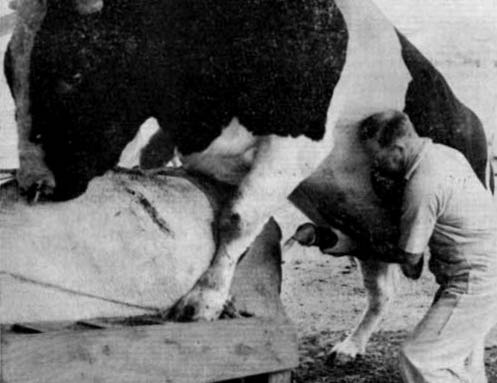
With a limited number of bulls kept at Berry we perhaps have a more intense study of bull behaviour than would normally be the case. Each bull has been collected from weekly, or on occasions bi-weekly. By constantly changing the decoy or teaser beast refusals to serve have been none over the last twelve months. A cow, a steer and a young bull are used as decoys.
The bull to be collected from is tethered in a collection yard from 5-10 minutes before he is led to the decoy. The bull is frustrated at his first mount and allowed to serve the second time he gets up. Frustration when not carried to excess increases the quality, and often the quantity, of semen ejaculated.
It is often an advantage to have other bulls in close proximity, and often a jaded bull will serve after watching the bull before him serve. We also have observed that when young bulls are run with older bulls the quality of the young bull's semen will deteriorate because he has tried to serve the older bull. This does not appear to happen when young and old bulls run together under natural conditions.
Dilution
Egg yolk-sodium citrate buffer dilutor appears to be the best dilutor and this is used at Berry.
Since the discovery that antibiotics added to semen of lower fertility bulls increased conception rates, it has become a regular practice to add sulphanilamide, penicillin and streptomycin to the dilutor. Streptomycin is added in the hope that it will control Vibriosis if an infected bull finds its way into the centre.
INSEMINATION
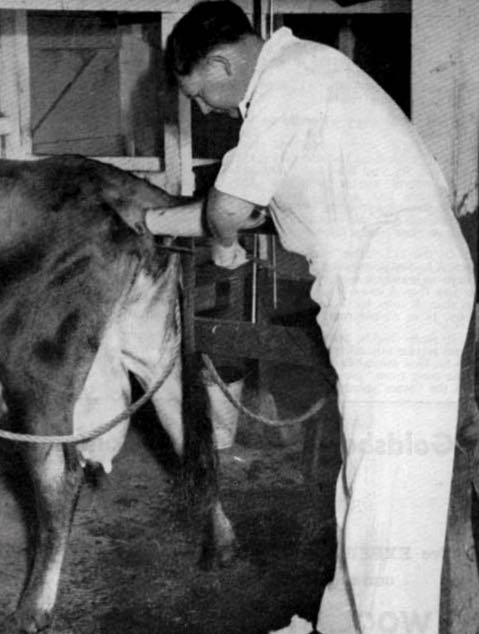
At Berry all inseminations are done by the rectal fixation method. Semen is deposited in the cervix.
Uterine inseminations have been discarded because:
1. There is less chance of interrupting an existing pregnancy with the cervical method.
2. There is a chance of uterine damage. There is experimental evidence to show that uterine damage with uterine inseminations may lead to early foetal death.
3. The cervical method is equally as effective and less time consuming.
All inseminations are done towards the end of the oestrus or some hours after.
LENGTH OF OESTRUS CYCLE
The majority of oestral cycles are 21 days duration, but wide variation may occur. There is a consistent 8-10 per cent. difference between 30 day non returns and 3 month non-returns. This no doubt can be explained in the majority of cases by early foetal death.
Old metritis cases tend to return at 4 to 8 weeks after insemination and it is possible that in the majority of instances this is due to early foetal death.
ORGANISATION AND COST OF A.I. SERVICE
A.I. centres are best located in the centre of areas to be served. Areas of greater than 10 miles in radius become economically unsound because of the extra mileage involved. Further extension is carried out best by the establishment of sub-centres.
The establishment of a centre with laboratory, bull yards, feed sheds, bulls and vehicles will involve a large initial cost, but thereafter sub-centres can be set up relatively cheaply.
For the main centre it is necessary to employ a veterinarian and two assistants; additional assistants being required for every 1500 cows inseminated.
Since the initial cost of establishment of a centre is great, the larger the number of cows inseminated from one main centre, the more economical will be the use of staff and bulls and the smaller will be the cost per cow. Major costs in a main centre will be the cost of the individual insemination. Most inseminators will inseminate on an average 1500 cows a year, although this will vary with the intensity of the numbers of cows.
The average inseminations for inseminators employed by the English Milk Marketing Board is 9 per day or roughly 1800 cows a year. In Australia, if each inseminator can look after 1500 inseminations annually this means roughly a cost of 10/- a cow for labour. English inseminators are paid half the salary of their Australian counterparts, reducing the cost to roughly 5/- per cow.
At Berry it has been necessary to travel 14 miles to get each cow in calf, and costing this at ninepence a mile adds a further, approximately. 10/- per cow. The English figure is 7 miles per insemination, or roughly 10 miles to each cow got in calf.
Good conception rates are almost as important to the individual farmer as is the use of better quality bulls, and especially is this so in the smaller herds where the production of every cow is important. Higher conception rates naturally will reduce greatly the labour and mileage costs.
Under existing South Coast conditions farmers can replace a bull with an extra cow, which will return him in the vicinity of £100 a year; so that even at £2 a cow A.I. would be no more costly than keeping a bull.
FUTURE USE OF A.I. IN AUSTRALIA
It has been the practice in New Zealand to give first preference to pedigree herds in A.I. centres and Dichart (1950) has suggested also that the same policy be adopted in Australia. In theory the plan to strengthen the bull breeding section of the industry is sound. However, in New Zealand this practice was not well supported by the breeders.
A.I. Centres can reduce costs by a small margin, but insemination always must be comparatively expensive.
The results obtained in England should not condemn A.I. Sire selection just has not been as efficient as it should be. If A.I. Centres are to produce the results expected in Australia, further thought must be devoted to sire selection, but insufficient unselected daughters are recorded at present to allow the selection of proven sires. Stations must breed and prove, and distribute semen only from those bulls which have been proved.
Although A.I. will continue to be costly in Australia there seems to be no other breeding policy which has as great a potential in raising production rapidly as a sound A.I. programme.
The photographs which follow illustrate the technique of collection and distribution of semen.
INFERTILITY IN CATTLE
It is difficult to define the term infertility, or to express in words what is meant by an infertile animal. The term infertility is relative, for absolute sterility or permanent infertility is relatively rare in the bovine. Temporary infertility is common. The true incidence has not been assessed; nor do we know whether is has increased in recent years. It may be that the apparent increase is due to economic changes within the dairy industry, where veterinarians are devoting more time to the problem and there is a deeper interest by the stockowner. It is well recognised, however, that infertility in cattle is an important cause of economic loss to the dairy industry. It commonly occurs as a herd problem and should be considered and treated as such.
FERTILITY AND CONCEPTION RATES—BERRY "INFERTILE" HERDS AND "PROBLEM" HERDS
Of the 1,729 cows inseminated at Berry from the inception of the scheme in October, 1952, to October 5th, 1953, 832 or 48 per cent. came from the herds in which the diseases affecting fertility, such as brucellosis, trichomoniasis or vibriosis, were suspected or known to exist.
Results from such "problem" herds (39 in all) have been tabulated separately from results over the other 112 herds using the Centre over the 12-month period, with the following results:
| Herd Group | Fertile to Services | Classified | Total | ||||||||
|---|---|---|---|---|---|---|---|---|---|---|---|
| 1st | 2nd | 3rd | Infertile | ||||||||
| No. | % | No. | % | No. | % | No. | % | No. | % | ||
| Problem | 39 | 408 | 49 | 183 | 22 | 105 | 13 | 135 | 16 | 831 | 100 |
| Other | 112 | 540 | 60 | 237 | 26 | 98 | 11 | 23 | 3 | 898 | 100 |
| Total | 151 | 948 | 55 | 420 | 24 | 203 | 12 | 158 | 9 | 1729 | 100 |
Of the 39 "problem" herds, 28 or 72 per cent. had cows classified as empty after A.I. However, of the 135 infertile cows in these herds only 69 or 51 per cent, have three services recorded at the Centre.
Of the 112 "other" herds, only 18 or 1.6 per cent. had cows still infertile after A.I., but any comparison between actual numbers of herds in the two groups is heavily biased by reason of the fact that 56 of the 112 herds submitted less than 5 cows for A.I. and only 3 of the 39 "problem" herds submitted less than 5 cows for A.I. Or the 23 cows classified as infertile in the other group, 14 or 61 per cent. have three services recorded at the Centre.
It seems highly possible that many of the cows still empty after first or second service might have held to second or third service had they been returned to A.I. One outstanding fact, however, should be noted: Whereas 16 per cent. of the cows from "problem" herds were classified infertile the comparable figure from the "other" herds was only 3 per cent.
CONCEPTION RATES
| Excluding Infertile Cows | Including Infertile Cows | |||
|---|---|---|---|---|
| C.R. | No. | C.R. | No. | |
| Problem | 1.56 | 696 | 1.68 | 831 |
| Other | 1.49 | 875 | 1.52 | 898 |
| Total | 1.53 | 1571 | 1.60 | 1729 |
Differences in conception rates, though small, highlight the differences between "problem" and other herds.
CAUSES OF INFERTILITY IN THE COW
1. Poor Husbandry:
It has become increasingly obvious at Berry that husbandry plays an important part in maintaining high conception rates in a herd. It is obvious that too short a period between calving and first mating produces poor conception rates. Cows should be calved at least 60 days, and preferably 85 days, to get the best mating results. However, a larger interval should be left if the cow has aborted, or has had difficult calving, to allow the uterus to return to normal. Cows which conceive at 85 days will allow them regularly to calve once each year.
Analysis of Results of Mating according to length of time between Calving and 1st Mating (Fertile Cows only). N.S.W. Herd Recording. Total of 288 Surveyed Herds.
| Interval between Calving and 1st Mating (Days) | No. of Cows | 1st Service % | 2nd Service % | 3rd or Subsequent Service % |
|---|---|---|---|---|
| 14 | 253 | 37 | 37 | 36 |
| 21 | 330 | 44 | 34 | 22 |
| 28 | 613 | 67 | 20 | 13 |
| 35 | 727 | 67 | 22 | 11 |
| 42 | 567 | 70 | 17 | 13 |
| 49 | 544 | 75 | 15 | 10 |
| 56 | 459 | 77 | 16 | 7 |
| 63 | 499 | 78 | 14 | 8 |
| 70 | 428 | 78 | 12 | 10 |
| 77 | 351 | 80 | 10 | 10 |
| 84 | 343 | 76 | 13 | 11 |
| 91 | 292 | 84 | 9 | 7 |
| 98 | 238 | 80 | 11 | 9 |
| 105 | 168 | 81 | 11 | 8 |
| 112 | 132 | 83 | 13 | 4 |
| 119 | 95 | 85 | 9 | 6 |
| 126 | 80 | 80 | 9 | 11 |
| 133 | 62 | 87 | 5 | 8 |
| 140 | 33 | 70 | 18 | 12 |
| 147 & over | 47 | 81 | 7 | 12 |
| Total & averages | 6261 | 72 | 17 | 11 |
Conception rates are also better if inseminations are done late in the heat period. However, the greatest causes of infertility are disease and other factors which can be controlled.
2. Brucellosis:
Brucellosis is the oldest recognised disease causing abortion in cattle. However, even with modern methods of combating the most important disease of dairy cattle so far as infertility is concerned.
The usual aftermath of a Brucellosis abortion is retained foetal membranes, metritis or pyometron, and sterility. In herds in which there is a high incidence of Brucellosis even cows which have normal calves will retain membranes and this, of course, always is associated with a high incidence of metritis and infertility.
Brucella abortions can occur at any time during pregnancy, but are more usual toward the 6th, 7th and 8th month. However, a considerable number of abortions have been observed at Berry in Brucella positive cows at the 4th and 5th month of pregnancy.
The use of Strain 19 vaccination has reduced greatly the losses due to abortion and, in consequence, infertility. In New Zealand a reduction in abortion from 10 per cent. in unvaccinated herds to 2 per cent. in vaccinated herds has occurred. Yet it is surprising, in view of the great reduction in abortions and in infertility in those herds where Strain 19 vaccination is used, how few calves are vaccinated each year.
3. Trichomoniasis.
Trichomoniasis is a disease of cattle, the noticeable symptoms of which are herd infertility and early abortions.
It is transmitted mainly by coitus and can be conveyed to inseminated females using semen from an infected bull. A feature of the disease is the extent to which it may spread within a herd or area, attracting little attention until a serious outbreak of infertility has been set up.
It can be traced down by history and can be confirmed in the laboratory provided a thoroughly persistent veterinarian is given reasonable access to the herd by the owner. The parasite can be recovered from foetal fluids or foetal stomach contents in reasonably fresh specimens or can be observed in specimens withdrawn from the vagina of cows. The latter examination is best done 12-19 days after an observed oestrus period.
Initially the conception rate may not be lowered markedly, but pregnancies are interrupted at from 6-12 weeks. Heifers are usually more difficult to get in calf than cows. Later, the conception rate is lowered and foetal death with retention and maceration may occur. Recovery is not complete in every case; some animals remaining infertile because of severe damage to the uterus.
Control is best done by using artificial insemination from a bull proved free of Trichomonas foetus. A sexual rest of three months, during which three oestral cycles must have been observed, is sufficient in most cases for conception with carriage to full term. It has been observed that this period is not always sufficient, however, since returns to oestrus have occurred in cows artificially inseminated and which already have had three months sexual rest.
In the absence of A.I. the best that can be done is to use a bull free from the disease until the majority of cows are in calf and then slaughter the bull, which has become infected. No reliable 100 per cent. cure has been found for infected bulls, so that all infected bulls or those suspected of being infected must be slaughtered. There is no evidence as to the length of time a cow can harbour infection and be potentially infective to a bull without showing any signs of disease. In some cases in which infection seems to have been present for some years it is likely that cows have harboured infection through out that period.
4. Vibriosis.
Vibriosis abortion was described many years ago as being responsible for some infertility in cattle, but subsequently has failed to attract attention for a long time. It may be that the symptoms of genital disease decreased to an insignificant level, or, what is more likely, the emphasis laid on Brucellosis was responsible for some measure of neglect. Recently there has been reason to suppose that vibrionic abortion may be widespread.
Sutherland (1954) has stated, "I am confident that the great bar to clarifying our knowledge of bovine infertility at present (in Queensland) is the imperfection of our diagnosis of Vibriosis."
Since the first diagnosis of this infection in Queensland (Simmons, 1949) the disease has been found to be widespread, causing chiefly infertility, and secondly abortion in cattle.
Rikard Bell (1954) also concludes that Vibriosis is widespread in Western Australia and is a cause of temporary infertility characterised by continual return to oestrus, often after long periods. Similar herd histories have been observed at Berry.
In vibrionic abortion the percentage of aborted foetuses is not high (10 per cent.) and the foetus can be aborted at from 3 to 6½ months. The first observed outbreaks of Vibriosis were diagnosed in Queensland, where heifers vaccinated with Strain 19 were observed to abort at five to six months.
Diagnosis of Vibriosis is difficult; the organisms being isolated from foetal stomach contents or from placental cotyledons. Blood agglutination tests are not reliable, but a mucus agglutination test is being used for individual and herd diagnosis.
5. Leptospirosis.
In some herds infected with Leptospira pomona abortions in cows have occurred.
In an acute attack of Leptospirosis the temperature is raised to 103 degrees or even 107 degrees; accompanied by rapid breathing, jaundice, anaemia and haemoglobinuria, and sometimes terminating in death after 2-4 days. Again, there may be only reduced milk yield, a rough coat and normal temperature. Leptospira can be isolated in the urine and a serum agglutination test is available.
6. Nutrition.
There is little positive evidence of the extent to which nutritional deficiencies may influence reproduction either directly or indirectly.
A level of nutrition sufficient to produce regular heats in cattle is not likely to affect the conception rate adversely. New Zealand experiments show that heifers on a low plane of nutrition conceive just as readily as those on a high plane, but that those on a high plane conceive less readily than those on a medium plane of nutrition. Low calcium and low phosphorus diets fed for three years had little effect on fertility. It has yet to be proved or disproved that cows, and more particularly heifers, being maintained on low phosphorus pastures on the coastal strip of Eastern Australia, where the deficiency interferes with regular oestral periods, conceive as readily as those on an adequate level of nutrition.
7. Other Causes.
(a) Freemartins occur in some 90 per cent of cases where heifers are born twin to a bull; a faulty development of the genital tract being usual. Cases observed in which freemartins have been reared at Berry have shown practically no development of the female genital tract.
(b) White Heifer Disease: This is a hereditary disease of cattle occurring mostly in white heifers of the Shorthorn breed, in which there is a persistent hymen and faulty development of the female genital tract. One case which occurred in a Shorthorn heifer was observed. Although the hymen was broken down and the heifer inseminated on a number occasions, conception has not resulted.
Causes of Infertility in the Bull.
New Zealand Dairy Board figures show that 10 per cent. of all bulls in a sample of 1258 had poor or inferior fertility (conception rates lower than 50 per cent.).
Distribution of Age Groups (N.Z. Dairy Board) of Inferior Fertility Bulls.
| Age-yrs | % | Age-yrs | % |
|---|---|---|---|
| 1 | 12 | 6 | 15.7 |
| 2 | 8 | 7 | 5.7 |
| 3 | 8 | 8 | 17.7 |
| 4 | 6 | 9 & over | 21.0 |
| 5 | 11.5 | Unknown | 13.8 |
Fertility examination at Ruakura during the last 4 years of 801 bulls coming from herds experiencing infertility
| No. | Fertility Check |
|---|---|
| 95 classed as | Good |
| 263 classed as | Moderate |
| 117 classed as | Weak |
| 132 classed as | Unsatisfactory |
| 139 classed as | Poor |
| 55 classed as | Sterile |
It seems from the laboratory examination that 55 per cent. were below moderate, and hence very likely to be contributing to the low fertility of these herds.
A considerable amount of sterility in bulls is due to lack of sperm production; this being found mainly in young bulls which have been overworked and underfed, and in old bulls which have been overfed and underused.
Variation of Conception Rates of Bulls at A.I. Centre, Berry.
| Friesians | |||
|---|---|---|---|
| Age | C.R. | % Conception on 1st | |
| No. 1 | 9 years | 1.46 | 68.6 |
| No. 2 | 1½ years | 1.66 | 60.3 |
| (Since withdrawn from use) | |||
| No. 3 | 1½ years | 1.28 | 78.4 |
| Australian Illawarra Shorthorns | |||
| No. 1 | 12 years | 1.41 | 70.9 |
| No. 2 | 8 years | 1.87 | 53.5 |
| (Since withdrawn) | |||
| No. 3 | 7 years | 1.40 | 71.5 |
| Ayrshires | |||
| No. 1 | 8 years | 1.49 | 67.0 |
| No. 2 | 3 years | 1.45 | 68.9 |
| No. 3 | 1½ years | 1.31 | 76.6 |
It has been shown at Ruakura, using twin bulls, that bulls in poor condition cannot give the amount of work that a well fed animal will. This is more marked with yearlings than with other age groups. Even with bulls up to 4 years old, high condition appears to be an advantage, but if older bulls get too fat there is a risk of them becoming too sluggish.
Wide variation in protein seems to have little effect on fertility, providing body condition is kept up.
Vitamin A supplementation may be necessary when no green feed is avail able, in those areas subject to long dry spells.
Analysis of No. Services/Pregnancy - Six Brucellosis-Positive Herds - Berry District.
| Insemination | HERD No. 1 | ||
|---|---|---|---|
| or | % of | % of | |
| Service No. | No. | Total | Remainder |
| 1st | 20 | 44 | - |
| 2nd | 15 | 32 | 60 |
| 3rd | 2 | 4.4 | 20 |
| 4th | 2 | 4.4 | 25 |
| 5th | 2 | 4.4 | 33 |
| Empty | 4 | 8.8 | 100 |
| Total | 45 | 100 | - |
| Insemination | HERD No. 2 | ||
|---|---|---|---|
| or | % of | % of | |
| Service No. | No. | Total | Remainder |
| 1st | 13 | 29 | - |
| 2nd | 11 | 25 | 36 |
| 3rd | 5 | 11 | 25 |
| 4th | 6 | 14 | 40 |
| 5th | 5 | 11 | 55 |
| Empty | 4 | 9 | 100 |
| Total | 44 | 100 | - |
| Insemination | HERD No. 3 | ||
|---|---|---|---|
| or | % of | % of | |
| Service No. | No. | Total | Remainder |
| 1st | 32 | 37 | - |
| 2nd | 17 | 20 | 38 |
| 3rd | 12 | 14 | 43 |
| 4th | 5 | 6 | 67 |
| 5th | 1 | 1 | 7 |
| Empty | 10 | 12 | 100 |
| Total | 87 | 100 | - |
| Insemination | HERD No. 4 | ||
|---|---|---|---|
| or | % of | % of | |
| Service No. | No. | Total | Remainder |
| 1st | 10 | 52 | - |
| 2nd | 3 | 16 | 33 |
| 3rd | 2 | 11 | 33 |
| 4th | 2 | 11 | 50 |
| 5th | 2 | 11 | 100 |
| Empty | - | - | - |
| Total | 19 | 100 | - |
| Insemination | HERD No. 5 | ||
|---|---|---|---|
| or | % of | % of | |
| Service No. | No. | Total | Remainder |
| 1st | 20 | 42 | - |
| 2nd | 7 | 15 | 30 |
| 3rd | 7 | 15 | 33 |
| 4th | 4 | 8 | 39 |
| 5th | 5 | 10 | 50 |
| Empty | 5 | 10 | 100 |
| Total | 32 | 100 | - |
| Insemination | HERD No. 6 | ||
|---|---|---|---|
| or | % of | % of | |
| Service No. | No. | Total | Remainder |
| 1st | 116 | 68 | - |
| 2nd | 21 | 19 | 37 |
| 3rd | 13 | 8 | 50 |
| 4th | 7 | 4 | 53 |
| 5th | - | - | - |
| Empty | 6 | 4 | 100 |
| Total | 169 | 100 | - |
| Insemination | BERRY A.I. CENTRE AVERAGE | ||
|---|---|---|---|
| or | % of | % of | |
| Service No. | No. | Total | Remainder |
| 1st | 948 | 60 | - |
| 2nd | 419 | 27 | 67 |
| 3rd | 205 | 10 | 70 |
| 4th | - | - | - |
| 5th | - | - | - |
| Empty | - | 3 | - |
| Total | 1572 | 100 | - |
References:
Handcock (1952): N.Z. Dairy Farmers' Annual
Sutherland, A. K., Simmons, G. C. and Kenny, C. C. (1952): Queensland agric. J., October, 1952.
Rendell, J. (1954): Personal communication.
Rikard-Bell, L. F. (1954): Aust. vet. J., 30 : 41.
Simmons, G. C. (1949): Aust. vet. J. 25 : 297.
Ward, A. H. (1953): N.Z. Dairy Farmers' Annual.
Rawson, L. E. A. (1954): Aust. Dairy Rev., 22 : 10.
Wishart, D. S. (1951): J. Aust. Instit. agric. Sci., 17 : 184.
Sutherland, A. K. (1954): Personal communication.
Volk, V. A. (1954): Personal communication.