ARCHIVE FILE
See the original document
INSTITUTE OF INSPECTORS OF STOCK OF N.S.W. YEAR BOOK.
The Residual Infertility Problem in Dairy Herds
T. J. McCLURE, B.V.Sc., Department of Veterinary Medicine, The University of Sydney
All of us are aware that most of the really severe herd mating problems are caused by male infertility. Vibriosis, or Trichomoniasis or combinations of these. All of us are aware that these causes do not account for all of the infertility and sterility that occurs, either the severe problems or the much more common, if less catastrophic, minor problems. These less severe infertility problems and their causes are of considerable importance both because of their direct economic effects and the difficulties they create in the diagnosis of male infertility, Vibriosis and Trichomoniasis. Recent survey in the United Kingdom and New Zealand have indicated that in a high proportion of herd mating problems the causes of the problems are not understood (Boyd and Reed 1961, McClure 1959). Infertility problems are changing in nature and cause as the result of increasing knowledge and application of control measures, with the result that male infertility, Vibriosis and Trichomoniasis are becoming rarer. This is certainly so in the more progressive dairying areas. The veterinary profession must advance with the times and be able to diagnose, treat, control and prevent the residual problems. All available evidence indicates that these problems will best be handled by preventive, or at the worst, control methods, hence they come within the advisory realms of the Veterinary Inspectors, for whom extension work is an important field of activity.
Herd mating problems are readily classified into four distinctive types:—
(a) failure of a significant proportion of the herd to show oestrus within a reasonable time of calving — a problem of suboestrum or anoestrum, (b) failure of a significant proportion of the herd to become and remain pregnant when mated — a low non-return rate or repeat-breeder problem, (c) failure of a significant proportion of the herd to become and remain pregnant after a mating season of reasonable length or by a reasonable period after first service — an empty or non-pregnant-cow problem and (d) when an abnormally high proportion of the herd returns to oestrus after having been apparently pregnant for a reasonable period — a delayed-return-to-oestrus problem.
THE ANOESTROUS / SUBOESTROUS PROBLEM
The herd mating problems of this type are mainly the result of malnutrition, such as gross underfeeding, carbohydrate, protein and/or mineral deficiencies (copper, cobalt and phosphorus). Rarely, problems arise in herds "apparently" on satisfactory rations. The causes of these latter problems are unknown and although it is not difficult to develop all sorts of theories to explain the facts, it is very difficult to prove these. The so-called "persistent corpus luteum" has been a red herring that has confused us for a long period. In regard to malnutrition, assessment of the nutritional status of cows without weighing at fortnightly or monthly intervals becomes meaningless. This is the reason why the Department of Veterinary Medicine has acquired mobile cattle scales to assist with its fertility studies.
THE LOW NON-RETURN RATE TYPE OF PROBLEM (REPEAT-BREEDER PROBLEM)
The causes of this include (a) the mating of cows to infertile, sub-fertile, sterile or impotent bulls, (b) the venereal infections Trichomoniasis and Vibriosis, (c) mating too many cows too soon after calving i.e., before they have attained their normal level of fertility, usually by about the 60th day after parturition, (d) a high proportion of cows with endometritis which can occur after abortion storms caused by Brucellosis, (e) movement of cattle from farm to farm especially shortly before insemination (Holt, 1962). The cause of these phenomena is not known, but Holt is of the opinion that the lowering of fertility is due to a lack of resistance to low-grade genital infection, (f) McClure (1961) described field evidence which suggested that there was a complex nutritional lactational stress infertility syndrome in dairy cattle fed on immature pasture and associated with a falling body weight at the time of mating. The changes in body weight, although appreciable and in the order of 5%-7%, are not detectable without weighing the cattle at fortnightly or weekly intervals from calving until mating, (g) faulty A.I. technique, and (h) outbreaks of pyrexia and it is likely that there are also other causes of herd infertility problems which are not yet recognised (McClure 1959).
THE NON-PREGNANT COW PROBLEM
Most of these problems are the result of the failure of a low non-return-rate-type of problem to recover rapidly, either spontaneously, or as the result of treatment. Some, however, occur independently. There are problems occurring in herds in which there is, for some reason or another, a large proportion of cows with endometritis, cervicitis, salpingitis, bursal adhesions,etc. The usual reason is endemic Brucellosis, usually in non-vaccinated herds.
THE DELAYED-RETURN-TO-OESTRUS PROBLEM
This problem may arise either when established pregnancies fail at any stage during the first two or three months, or when cows pass into suboestrum after overt oestrus and mating which for some reason or other does not result in conception or maintenance of pregnancy. In these cows normal oestrus cycles recommence at some later stage, usually after the peak of the lactational curve.
Apart from the causes of infertility associated with failure of mating (anoestrum or suboestrum or lack of libido) which on progressive dairy farms is uncommon, most of the problems are of the low non-return rate type and its extension, non-pregnant cow problem. In these animals the failure of the reproductive cycle occurs at one of two times, either failure of fertilisation or death of the ovum or at a subsequent stage of its development — commonly termed embryonic mortality. In cattle little is known of the causes. This subject was recently reviewed by Hanly (1961). In cows with histories of infertility the estimated pre-natal mortality rate in the first five weeks of gestation was 40-60 per cent, in herds without histories of infertility the rate was 15-21 per cent. The causes of early embryonic mortality include Vibriosis, Trichomoniasis, fertilisation of stale ova (due to insemination after ovulation) and inbreeding. Hanly concluded that "residual embryonic death would seem to have to be accounted for by a more universally active factor than any of those so far investigated."
It is obvious therefore that a great deal more fundamental and applied research is urgently required. Until this is done there is little that can be offered in the treatment of those problems of, at present, unknown cause. However, there is a great deal that can be done in the field such as the application of methods of analysis of mating data and use of diagnostic techniques both of which are already known. Both are complementary and neither is fully effective without the other.
In order to use these in New South Wales three things will have to be done, the dairy farmers must keep accurate mating data, consisting of, for each cow, her name or number, age, last calving date, all subsequent oestrous dates, and records of matings and identifications of the bulls used. Veterinary surgeons must develop the ability to analyse these data and diagnostic laboratories must be established within reasonable distance of the dairying areas and be equipped and staffed to perform the necessary laboratory examinations.
As veterinary surgeons in advisory practice, the members of the Institute of Veterinary Inspectors can contribute greatly to the first two of these requirements.
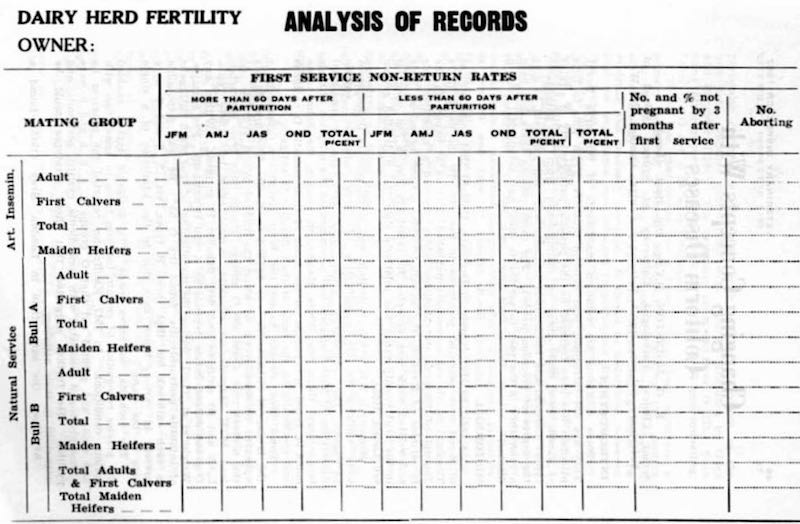
Having recovered satisfactory mating records they can be analysed on the lines indicated by table 1. Analysis on this basis provides the following information and allows the following mating group comparisons:
Total first service non-return ("conception") rate, proportion of herd which is not showing oestrus by parturition plus 60 days, proportion of herd aborting, proportion returning to oestrus after apparently being pregnant, i.e. it shows up the existence of an infertility problem and classifies it into the type of problem, anoestrusetc.
Proportions of the herd mated for the first time more and less than 60 days after calving and a comparison of the first service non-return rates for each group may indicate a problem caused by mating too many cows too soon after calving, comparisons of non-return rates of artificially inseminated cows and naturally mated cows (may indicate male infertility, venereal infection, or faulty A.I. technique problems or problems of unknown cause when both A.I. and natural service results are poor), comparison of the non-return rates of bulls, may indicate male infertility or venereal infections, comparison of the non-return rates of first calvers with the adult cattle (may indicate endemic chronic venereal infection) comparisons of special groups of cows in the herd,e.g. recently bought-in stock with the home-reared stock and comparison of the non-return rates of cows on a chronological basis.
Just as history is accepted in the making of clinical diagnoses only when it is consistent with the clinical findings so are laboratory findings; the mere finding of a few vaginal mucus samples giving positive results on V. fetus agglutination test; cannot by any stretch of the imagination be made to indicate that the whole problem, or even part of the problem, is caused by Vibriosis, unless all clinical data including results of analysis of mating records indicate that V. fetus could account for the clinical picture. This does not decry the value of laboratory aids for they are essential for confirmation of the diagnosis; it only stresses the importance of correct interpretation.
In conclusion, to emphasise the importance of looking deeper into herd mating problems, I should like to say that I have seen very few simple uncomplicated Vibriosis problems; most have shown up the concurrent existence of other, often unidentified factors depressing fertility. Most of us working on bovine infertility have experienced the two extremes, herd problems recovering spontaneously and problems remaining despite the removal of the apparent cause of the problem such as Trichomoniasis.
References:
- Boyd, H. and Reed, H. C. B. (1961) — Agriculture, 68: 346
- Hanly, S. (1961) — J. Reprod. Fertil., 2: 181
- McClure. T. J. (1959) — N.Z. vet. J., 7: 31
- McClure. T. J. (1961) — N.Z. vet. J., 9: 107
- Holt, A. F. (1962) — Brit. vet. J., 118: 293