
ARCHIVE FILE
This article was published in 1967
See the original document
INSTITUTE OF INSPECTORS OF STOCK OF N.S.W. YEAR BOOK.
Problems associated with Intensive Sheep Production
K. G. HAUGHEY, B.V.Sc., Department of Veterinary Medicine, The University of Sydney, Camden, N.S.W.
In recent years research on the selection, establishment and maintenance of improved pasture has placed in the hands of the farmer an outstanding means of increasing the productivity per acre of his flocks and herds. Pasture improvement is an essential prerequisite to the intensification of production by grazing animals. The aim of intensive pasture production is to provide a continuing supply of high quality nutrients for the grazing animal. The techniques involved include the selection of suitable plant species, the provision of the requisite plant nutrients and the management of both the grazing animals and pasture to ensure high levels of pasture production. It is well to remember that the animal is as essential to the continued well-being of the pasture as the pasture is to the health and productivity of the animal. While the commercial application of research findings has brought tremendous benefits to the livestock industries, it is inevitable that, under the wide variety of environments under which they are commercially applied, problems will arise. The problems may affect the health and productivity of the grazing animals, e.g. bloat and legumes, or there may be a causal relationship between lowered productivity of the pasture and the grazing manage overgrazing. Other problems may arise indirectly because increased pasture production permits higher grazing densities and therefore increased opportunity for the spread of infectious and parasitic disease, e.g. footrot and helminthosis. Again, contagious ecthyma may become a problem because increasing soil fertility and overgrazing allow thistle infestation to become widespread.
Before passing to the main part of the talk, we can spend a few minutes reviewing some of these problems.
Serious disturbances of ovine reproduction associated with the ingestion of oestrogenic isoflavones are well known.
Varieties of sub-clover were first incriminated by Bennets et al. (1946) in Western Australia. Since that time the syndrome has been recognised widely throughout southern Australia. Red clover (T. praetense) also has been shown to produce the same syndrome (Barrett et al. 1965). Temporary infertilities of sheep, persisting for approximately three weeks after removal from the incriminated species, have been demonstrated in ewes grazing red clover during the mating period (Morley et al. 1964, 1966a). A similar syndrome affecting cattle grazing sub-clover dominant pastures has been reported from Tasmania (Thain 1963, 1966). While there are genetic differences between clover strains in isoflavone content (formononetin and genistein) the environmental factors of temperature, light and phosphate supply also influence isoflavone content. While the diagnosis of the syndrome of permanent infertility associated with cystic endometrium does not present many difficulties, the diagnosis of the temporary infertility syndrome does. Teat length changes in wethers (Braden et al. 1964) are useful but lack specificity, e.g. lucerne grazing gives a teat length response not paralleled by an infertility or a uterine weight response (Bennett, 1966). Apart from manipulating the legume content of pasture there have been no advances in the control of the problem. Morley (1966b) has questioned the desirability of selecting for strains low in isoflavones on the grounds that isoflavones may be part of the plant's immune mechanism. Pisatin produced in response to some microbial infections in peas is an isoflavenoid. Pithomyces chartarum is a powerful generator of pisatin on green pea pods (Cruikshank and Perrin, 1965). Morley's warning is salutary: "The veterinarian and the agriculturist should be wary of an attitude which regards phyto-oestrogens as simply harmful. Apart from possible benefits to animal growth, they may be important components in plant survival. Perhaps we should attempt, not to get rid of them, but rather to understand them and learn to live with them."
Sheath rot is largely a disease of the Tablelands environment. The association between the availability of high-quality pasture and incidence of external lesions has been recognised for a long time. Southcott (1965) demonstrated that the diphtheroid organism hydrolyses urea to ammonia and that urine is necessary for experimental establishment of infection. He suggests that the initiation of external lesions depends on the release of ammonia, in concentrations harmful to tissue, from urine enriched with urea as a consequence of a high-protein diet. Control of the disease adds another operation to the process of wool raising. Although implants of testosterone proprionate (Osborne and Widdows, 1961, and Southcott, 1962) are a useful control measure, it is not the complete answer. Southcolt's suggested method of control, based on disinfection and quarantine, has yet to be adequately tested in the field.
Bloat can be a serious problem of both dairy and beef-cattle herds. Although its occurrence was recorded in the literature some 1900 years ago there appears to have been a considerable increase in incidence paralleling the more widespread use of pasture improvement. Aetiology is complex and is not completely understood. It is clear, however, that there are animal-plant interactions and that plants contain compounds which form stable foam in the rumen under certain conditions. For the dairy farmer the use of oil-emulsion pasture sprays gives effective control. The very nature of beef-raising makes such measures largely impracticable and the problem remains.
There is a general relationship between magnesium levels in herbage and the occurrence of hypomagnesaemia in ruminants. The relationship is not simple but there is no doubt that hypomagnesaemia does not occur when herbage magnesium levels are high (0.2 per cent). High soil nitrogen and potassium lower herbage magnesium, thereby increasing the risk of hypomagnesaemia. The build-up of soil nitrogen and potassium by nitrogen fixation, the return of dung and urine or manurial treatment are integral associations with pasture improvement.
Pasture improvement in areas where the soil levels of the micro-elements copper and cobalt are marginal may lead to the development of deficiency syndromes in grazing animals that were not apparent before pasture improvement. One explanation apparently is that the increased fodder grown dilutes the soil levels available so that the animal intake of the elements is insufficient to meet animal requirements. Hartley and Grant (1961) have postulated that there may be factors present in pasture which interfere with availability or metabolism of selenium. Carotene, the precursor of vitamin A, is the rachitogenic factor in green cereal crops and pasture grasses that reduces the availability of Vitamin D which may result in ovine rickets (Grant, 1954).
Peracute, acute and chronic syndromes, the first characterised by sudden death and the others by predominantly neurological signs, are associated with the grazing of Phalaris tuberosa (Gallagher et al. 1966). The disease occurs most commonly on phalaris pastures growing rapidly after the "break". The peracute and acute forms are caused by the toxic effects of tryptamine alkaloids present in the herbage and it is suggested the mechanism of action of the alkaloids is by interference with the metabolism and function of serotonin, a normal constituent of mammalian tissue. Serotonin has powerful pharmacological properties on smooth muscle, cardiac activity and influencing the function of the central and autonomic nervous systems. In the chronic syndrome the relationship between ingestion of the alkaloids and the development of degenerative lesions resulting in long-lasting neurological defects is not known.
Facial eczema was first recorded in Victoria in 1956 (Flynn, Hore, Leaver and Fisher, 1962). Outbreaks were recorded on a number of improved pastures ranging from top-dressed native pastures to sown-down pastures of perennial ryegrass and white clover. The germination of the spores of Pithomyces chartarum demands temperatures in the 70°-100°F. range, relative humidity approaching 100 per cent and a continuous supply of substrate in the form of dead leaf material which may be brought about by drought, continuous grazing by animals, normal process of senescence of plants or the activity of pasture insect pests. The occurrence of facial eczema is perhaps an example of the indirect effects of intensive pasture production on animal health. Harvesting of fodder involves damage to plants by grazing and trampling. The increased food supply provided by pasture improvement has seen large increases in the population of insect pests.
Syndromes characterised by neurological disturbance and liver damage are associated with the grazing of the lupin species, L. varius and L. angustifolius (Bennetts, 1957).
The problems reviewed to date have largely affected the grazing animal but it is well to remember that the animal can have undesirable effects on plants and soil in the eco-system. Hilder (1964) showed that the camping habits of the Merino resulted in the concentration of the plant nutrients, calcium, potassium, magnesium and phosphorus, in the camp area at the expense of the rest of the paddock. Much of the value of dung and urine was lost because of its concentration in a small area of the paddock, e.g. 22 per cent of the dung was deposited in 3 per cent of the paddock area the concentration being 10-15 times the paddock average.
Overgrazing prejudices the subsequent ability of the pasture to produce herbage at high levels by reducing the plant tissue capable of photosynthesis. Brougham (1961) showed that when frequent defoliation was carried out at two levels, 3 in.-1 in. and 7 in.-3 in.(sic), the dry matter (D.M.) production of a mixed sward was double at the higher cutting level. Frequent defoliation to the extent of leaving a green material pasture residue of less than 1450 lb. D.M. resulted in depression of subsequent pasture production. In passing it is worth mentioning that high grazing pressures result in increased teeth wear of sheep. The increased rate of wear is directly related to the amount of soil consumed (Healy and Ludwig. 1965).
Then there are the problems associated with the utilisation of high producing pastures. The economist is interested in financial input/output relationships. There is a considerable gap between the estimated productivity of improved pastures and the general level of their productivity, e.g. pasture improvement has contributed an additional 1.3 ewe equivalents/acre to the area improved whereas many field experiments suggest that his figure be doubled or trebled (Kinsman and McLennan, 1961).
There is general agreement that increased stocking rates can be the quickest way of increasing animal production from pastures. There is considerable argument as to which grazing management system is the most efficient and it is unlikely that such arguments will be resolved as it would be dangerous to generalise about grazing systems under the wide differences of environment and type of enterprise under which they are applied. Increased stocking rates result in the consumption by the grazing animals of a higher proportion of the herbage grown. As stocking rate increases the supply of herbage relative to animal needs decreases, i.e. grazing pressure increases. High grazing pressures involve more work in harvesting daily intake. The energy involved in the additional work of more biting, more walking, longer grazing times may be two to three times that required under low grazing pressure, i.e. an ample supply of easily harvested grass. There is a limit to time sheep will spend grazing no matter how short the feed. Arnold (1963) states this to be 10-10½ hours for wethers and more than 11 hours daily for ewes in early lactation. Under high grazing pressures intake requirements may not be satisfied despite extended grazing times. Thus the additional work of harvesting, reduced intakeetc., result in a lower proportion of nutrients being available for production resulting in lowered production per animal.
Thus high-pressure grazing systems are characterised by relatively high output per acre but relatively low output per head compared with low-pressure grazing systems. There is greater variability in output between years and a greater likelihood for the necessity of hand feeding. Watson (1964) has summarised the position relating to high and lower pressure grazing systems. High-pressure grazing systems result in more sheep, wool, lambs weaned and more deaths/acre than low-pressure grazing systems. On the other hand, high-pressure grazing systems result in less wool, less lambs weaned/ewe mated, more teeth wear/sheep than low-pressure grazing systems.
High-pressure grazing systems work well where the product marketed, e.g. wool, butter, cheese, milk, is sold without particular reference to the animal that produced it. But it cannot be pushed so far in those livestock enterprises where individual animal performances are important, e.g. prime lamb and beef raising, breeding. Wool production/head is not depressed to the same extent with increased stocking rates as lamb growth rates, lambs weaned and mortality rates (Willoughby, 1966).
There is little point in producing increases in the weight of crossbred lambs weaned/acre if the body condition of the lambs is such as to make them less readily marketable. Arnold and Bush (1962) compared output of crossbred ewes at 4 and 7 ewes/acre. Although wool cut/acre and lamb liveweight/acre were increased, the lamb carcass weight/acre was only 7 lb. more at the higher stocking rate. Tribe and Lloyd (1962) demonstrated that growth rate and wool production of individual lambs decreased and production/acre increased, as stocking rate was increased from 1.5, 4.5 and 9 ewes/acre. They concluded, however, that the stocking of 9.0 ewes was less profitable than 4.5/acre without taking into account the long-term effects on the subsequent productivity of the sward at the higher stocking rate. The rearing of maiden replacements is unprofitable if a high proportion do not join successfully because of low body weight. Field veterinarians are frequently called to investigate groups of individual animal performances, particularly weaner unthriftiness and low proportions of ewes lambing, and they are faced with the difficulty of making an assessment as to whether inadequate intake of feed or other factors contribute to the problem.
This brings us to what I believe is our greatest problem associated with intensive pasture production. How do we establish the relationship between general levels of nutrition on the property and animal health? How do we equate the highly seasonal feed requirements for health and production of grazing animals with the highly seasonal supply of pasture? What steps do we take as veterinarians, to establish the contribution that inadequate nutrition might make to syndromes like lamb and weaner unthriftiness, perinatal lamb mortality and a lower proportion of ewes lambing?
As veterinarians we may reasonably be expected to estimate whether the fodder grown is sufficient to meet the maintenance and production requirements of the stock carried.
On most properties carrying capacity is arrived at by trial and error. In the majority of cases, the number of stock carried is coloured by long and bitter experience of the great between-year differences in fodder production, with the result that carrying capacity is underestimated. This is well illustrated by the figures quoted earlier (Kinsman and McLennan, 1961). But there are the adventurous few who may extrapolate from research findings for one type of livestock enterprise, e.g. wool growing, where there is minimal season variation in animal demand to another, e.g. prime lamb raising or breeding enterprises, where there are considerable seasonal fluctuations in feed demand by the animal. Carrying capacities have also been estimated, by people who should know better, by dividing the estimated total D.M. pasture production/acre by the annual D.M. intake requirement of a ewe, wether or cattle beast as the case may be. The annual intake requirements might be those of an 80 lb. ewe for example and extrapolated to Crossbred ewes averaging 120 lb. B.W. This, of course, does not recognise that liveweight influences intake requirements nor does it recognise the time relationship between seasonal production and seasonal fluctuations in intake requirements of breeders and young growing animals.
Two basic pieces of information are essential to the solution of the equation:
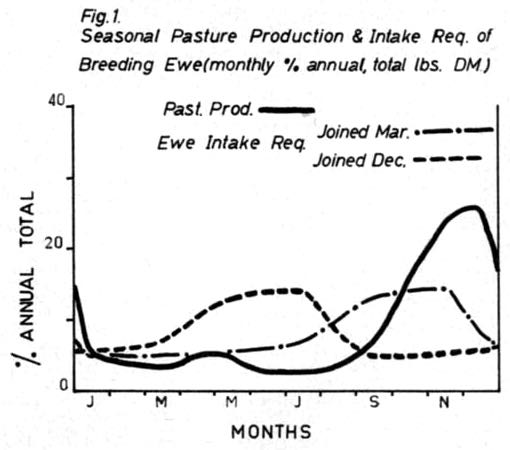
(1) Pastures—An estimate of the D.M. pasture production of the area by months. Approximately 60-70 per cent of total D.M. production is produced in one quarter of the year. There is also substantial variability in production between years.
(2) Grazing animals.
(a) Estimates of the total annual D.M. intake requirements for the different classes of livestock to meet nominated production performances.
(b) A knowledge of the fluctuating intake requirements of some classes of stock because of the demands of pregnancy, lactation and growth. This latter is important because the periods of increased animal demand frequently do not coincide with periods of increased pasture availability. The general relationship between pasture production and intake requirements of a spring- and autumn-mated ewe flock is set out in Fig. 1.
If we have information for different classes of stock relating to annual intake requirements and fluctuating requirements through the production year, I believe we are in a position to calculate estimates of the monthly D.M. intakes for the flocks and herds on the property.
ESTIMATION OF MONTHLY D.M. PRODUCTION
Given details of area, pasture species, manurial status of soils, climate, etc., it is possible to estimate monthly production from the pasture production curves of similar environments. The easiest method of obtaining the information is an approach to the District Agronomist, Department of Agriculture.
ESTIMATION OF ANIMAL INTAKE REQUIREMENTS
A sheep farm is usually a complex enterprise consisting of ewe breeding flocks for breeding, prime lamb raising or both. Wethers may be run for wool production. There may be ewe weaner replacements and wether and crossbred weaners may have to be fattened for slaughter. In addition there may be breeding cows, beef weaners, yearlings, etc.
Before the annual intake for each class of stock can be calculated, it is necessary to nominate production performances as nutrient maintenance and productive requirements will vary with liveweight, growth rate, length of lactation, etc.
The basis of calculating intake estimates in this talk are taken from a paper by Coop (1965). His estimates were derived from a consideration of feeding standards arrived at from both penned feeding experiments in Europe, Britain and the U.S.A.-i.e. the S.E, and TDN systems, and the results of more recent experiments with grazing animals in this part of the world. Intake estimates are given in lb. D.M. grass converted from D.O.M. data. Before passing to his estimates we will discuss a few definitions, etc. D.M. grass is assumed to be 88 per cent O.M., and 70 per cent digestible to give a D.O.M. of 62 per cent - TDN 64 per cent = SE 56 per cent. The digestibility of the O.M. of grass varies from 80-85 per cent where young and leafy through 70 per cent when more mature and down to 55-60 per cent when brown and stalky.
By far the greatest proportion of annual intake requirements in grazing animals are for maintenance, being approximately 80 per cent for sheep, 70 per cent for beef cattle and 60 per cent for dairy cattle. So we will give some consideration to the main factors affecting maintenance requirements of grazing animals.
Liveweight—maintenance varies as liveweight—W0.73, This means as a rough approximation that a 10 per cent liveweight increase will require a 7 per cent increase in maintenance requirement.
The Cost of Grazing—the estimates of maintenance requirements of pen-fed sheep in the UK, and U.S.A. standards have been shown to be much too high on the basis of recent work (Coop, 1961). Depending on the grazing pressure, which is a relative measure of the amount of work involved in harvesting intake, the cost of grazing has been variously estimated to be 10-33 per cent higher than for housed sheep (Lambourne, 1901; Coop and Hill, 1962; Lambourne and Reardon, 1963; Coop and Drew, 1963; Langlands et al. 1963; Grimes, 1966). Under low grazing pressures requirement is increased 10-30 per cent over housed hand-fed sheep and under high grazing pressures, i.e. 8-9 hours or longer grazing time on short or spare pasture, requirement may be increased 50-100 per cent. The increases largely offset the errors in the U.S.A. and U.K. standards so that the latter are not greatly in error if applied to grazing sheep.
On the other hand the overseas standards appear to underestimate the intake required for maintenance in grazing dairy cows (Wallace, 1956; Wallace, 1961; Hutton, 1962).
Climate—The effect of climate, cold, wind, rain on maintenance requirements of cattle is not known. But exposure can cause significant increases in maintenance requirements of sheep, especially if recently shorn. The increase may be about 10 per cent in full-woolled sheep ranging up to 60 per cent in recently shorn sheep.
It is clear then that liveweight, grazing pressure, insulation and climate affect maintenance requirement and that these factors must be considered when calculating intake requirements. Coop (1965) has taken liveweight, grazing pressure, shearing times, etc., into consideration in drawing up his estimates, e.g. Table 1 sets out assumed grazing pressures for the intake requirements given in Table 2.
Data relating to D.M. intake requirements to meet nominated animal production performances are given in Table 2 and Appendix 1. Lambing percentages are for autumn mating. In the case of spring mating lambing would be an estimated 15 per cent lower.
TABLE 1. Assumed Grazing Pressures Months/Year (after Coop, 1965).
| Grazing Pressure | Class of Stock | ||||||
|---|---|---|---|---|---|---|---|
| Ewe 80 lb. | Ewe 120 lb. | Ewe 140 lb. | Studs | Wethers | Ewe Weaners | Grade Rams | |
| High | 4-5 | 3 | 2 | 0 | 6 | 2 | 4 |
| Low | 7-8 | 9 | 10 | 12 | 6 | 10 | 8 |
TABLE 2. Summary D.M. Annual Intake Requirements of Grazing Animals (Coop, 1965, N.Z. Agriculturalist 1, No. 3, November).
| Class of Stock | Liveweight (lb.) or Liveweight change | Lambing/ Calving % | I.b. D.M. Intake |
|---|---|---|---|
| Sheep | |||
| Ewes | 80 | 70 | 1030 |
| 100 | 90 | 1180 | |
| 120 | 100 | 1310 | |
| 140 | 120 | 1430 | |
| Wethers | 80-90 | 740 | |
| 110-120 | 920 | ||
| Weaner, 2-tooth | 50-90 | 810 | |
| Ram | 160 | 1080 | |
| Dairy Cows | |||
| Jersey | 800 | 9100 | |
| Friesian | 1200 | 11,700 | |
| Beef Cattle | |||
| Breeder | 1000 | 100 | 8300 |
| Weaner | 300-600 | 4600 | |
| Yearling | 600-800 | 5200 | |
| 2-year-old | 800-1000 | 6200 | |
| Weaner | 350-750 | 5200 | |
| Yearling | 750-1100 | 6600 |
TABLE 3. Percentage of Animal Feed Requirement, by Months (after Coop, I. E. (1965), N.Z. Agriculturalist 1, No. 3, November).
| Months After Mating | EWES* | DAIRY COWS | BEEF COWS*** | |||||
|---|---|---|---|---|---|---|---|---|
| Rearing Single | Rearing Twin | Physiological State | Jersey** | Friesian** | Physiological State | Physiological State | ||
| 1 | 5.4 | 4.6 | Pregnant non-lactating | 9.7 | 8.6 | Pregnant lactating | 10.3 | Pregnant lactating |
| 2 | 5.6 | 4.8 | 9.5 | 8.6 | 10.5 | |||
| 3 | 5.8 | 4.9 | 9.3 | 9.3 | 10.6 | |||
| 4 | 7.0 | 7.0 | 9.0 | 9.7 | 10.7 | |||
| 5 | 10.8 | 11.4 | 8.6 | 9.7 | 5.9 | Pregnant non-lactating | ||
| 6 | 13.3 | 15.0 | Non-pregnant lactating | 8.2 | 9.2 | 5.9 | ||
| 7 | 14.3 | 15.8 | 7.8 | 8.4 | 5.9 | |||
| 8 | 14.3 | 16.0 | 6.2 | 6.1 | 6.0 | |||
| 9 | 8.0 | 7.4 | 5.2 | 5.1 | Pregnant non-lactating | 7.3 | ||
| 10 | 5.1 | 4.3 | Non-pregnant lactating | 7.5 | 7.4 | 8.1 | ||
| 11 | 5.1 | 4.3 | 9.0 | 8.6 | Non-pregnant non-lactating | 8.3 | Non-pregnant lactating | |
| 12 | 5.3 | 4.4 | 10.0 | 9.3 | 10.0 | |||
| 100.0 | 100.0 | 100.0 | 100.0 | 100.0 | ||||
* EWES - 120 lb. L.W. producing 250 lb. milk in 3½ months. Lamb weaned at 50-60 lb.
** JERSEY - 800 lb. L.W. producing 600 gallons of 5.5 per cent fat test milk in 280-300 days'
lactation.
** FRIESIAN - 1200 lb. L.W. producing 900 gallons of 3.6 per cent fat test milk in 280-300 days'
lactation.
*** BEEF COWS - 1000 lb. L.W. producing 200 gallons of 3.6 per cent fat test milk in 6 months lactation.
Calf weaned at 300 lb. L.W.
Seasonal fluctuations in intake requirements are given in Table 3.
This table is a guide only to relative needs/month because it assumes that bodyweight remains static throughout the year. In practice, of course, this does not occur. All stock possess considerable powers of resilience to fluctuations in feed supply, building up tissue in periods of excess and using it as a reserve in times of deficit. This phenomenon frequently carries animals through troughs in feed supply, e.g. autumn-mated ewes often lose tissue between mating and lambing without apparent serious effect on the ewe or the lamb's ability to survive and can be taken advantage of to increase the efficiency of utilisation of pasture.
Given monthly estimates of D.M. pasture production and animal D.M. intake requirements models can be constructed for properties which approximate the general relationship between the feed available and intake requirements to meet nominated animal production performances. In other words we have a rational basis for estimating carrying capacity having regard for both per acre production and individual animal performance. We can get some idea of general level of nutrition on the property. In particular, when applied to flocks and herds which have a large breeding and fattening component the method can be used to give an assessment of the possible relationship between the general level of nutrition and the occurrence of syndromes characterised by low levels of individual animal performance.
It is emphasised that in calculating the intake requirements a considerable number of assumptions have been made, e.g.: (i) allowances for grass eaten by progeny during lactation, (ii) the requirements for beef cattle are the same as for dairy cattle, and (iii) that 100 per cent of fodder grown is harvested by the animal during periods of deficit.
The calculations give us an estimate only of the animal requirements. Further sources of error will arise from environmental effects, e.g. climate, grazing pressure, etc. The sheep intake requirement seems well founded as there is general agreement between measurements made in different parts of the world. Unfortunately there is not such general agreement regarding the requirements for cattle. Thus the higher the proportion of cattle run on the property, the greater the possibility of error.
Notwithstanding these limitations I believe this approach goes a considerable way to filling the void when the question is posed:
"How do we establish the relationship between general levels of nutrition on the property and animal health?"
Appendix 1. Definitions of Stock Classes (Coop, 1965).
SHEEP
Breeding Ewe—B.W. 120 lb. entering flock as 100 lb. B.W. 2-tooth maiden and gaining 5 lb. B.W./annum to be cast at 6 years at 130 lb. B.W. mated in the autumn. Weans one lamb at 50-60 lb. after a 14-week lactation&250 lb. milk. Allowance for pregnancy, 2 x Birth Weight of lamb (lb. D.O.M.). Allowance for grass eaten by lamb during lactation, 2 x Weaning Weight (lb. D.O.M.).
Weaners, Replacement—Gain 40 lb. weaning—2-tooth. Gain allowed at 1.5 lb. D.O.M./lb. gain at 60 lb. B.W. increasing to 2.0 lb. D.O.M./lb. gain at 90 lb. B.W.
Weaners, Fattening—Marketed at 85 lb. LW. Rate of gain, 3 lb. B.W./ week, requiring 90 lb. D.M. intake/month.
Wethers&mdsh;Normally run on harder country 80 lb. as 2-tooth-110 lb. B.W. adult.
Ram—160 lb. B.W. no change throughout the year.
Stud sheep—Usually heavier than grade sheep.
Maiden 2-tooth ewe - 110 lb.
Ram hoggett - 140 lb.
DAIRY CATTLE
Jersey—800 lb. B.W. producing 600 gallons 5.5 per cent fat test milk in 280-300 days. No allowance for calf after birth.
Friesian—1200 lb. B.W. producing 900 gallons 3.6 per cent fat test milk in 280-300 days. No allowance for calf after birth.
BEEF CATTLE
Breeder—1000 lb. B.W. milk yield, 200 gallons 3.6 per cent fat test milk in 6 months' lactation. Calf weaned at 6 months at 300 lb. B.W. Allowance for pregnancy 2 x Birth Weight of calf (lb. D.O.M.). Allowance for grass eaten by calf during lactation—2 x Weaning Weights (lb. D.O.M.).
Weaner—gains 300 lb. to be 600 lb. B.W. at 1½ years.
Yearling—gains 200 lb. to be 800 lb. B.W. at 2½ years.
2-Year Steer—gains 200 lb. to be 1000 lb. B.W. at 3½ years.
On good country, calculate—
Weaner, 350-750 lb., from 6 months - 1½ years.
Yearling, 750-1100 lb., from 1½-2½ years.
REFERENCES
Arnold, G. W. (1963) — Wool Techn. & Sheep Breeding 10:No. 1:19
Arnold, G. W., and Bush, I. G. (1962) — Proc. A.S.A.P. 4:121
Braden, A. W. H., Southcott, W. H. and Moule, G. R. (1964) — Aust. J. Agric. Res. 15:142
Barrett, J. F., George, J. M, and Lamond, D. R. (1965) — Aust. J. Agric. Res. 16:189
Bennett, D. (1966) — Aust. vet. J. 42:364
Bennetts, H. W. (1957) Aust. vet. J. 33:277
Bennetts, H. W.Underwood, E. J. and Shier, F. L. (1946). — Aust. vet. J. 22:2
Brougham, R. W. (1961) — Proc. N.Z. Soc. Anim. Prod. 21:33
Coop. I. E. (1961) Proc. N.Z. Soc. Anim. Prod. 21:79
Coop. I. E. (1965) — N.Z. Agricultst. 1:No. 3
Coop, I. E. and Drew, K. R. (1963) — Proc. N.Z. Soc. Anim. Prod. 23:53
Coop. I. E. and Hill, M. K. (1962) —). Agric. Sci. 58:187
Cruikshank. I. and Perrin, Dawn (1965) — Aust. J. Biol. Sci. 18:817
Flynn, D. M., Hore, D., Leaver, D.D., and Fisher, Eileen E. (1962) — Bull. 2803/62, "Facial Eczema", Dept. of Agric. Vict. Aust.
Gallagher, C. H., Koch, J. H., and Hoffman, H. (1966) — Aust. vet. J. 42:279
Grant, A. B. (1954) — Proc. N.Z. Soc. Anim. Prod. 14:77
Grimes, R. C. (1966) — J. Agric. Sci. 66:211
Hartley, W. J., and Grant, A. B. (1961) — Fed. Proc. 20:No. 2, Pt 1:679
Healy, W. B., and Ludwig. T. G. (1965) Nature 208:No. 5012:806
Hilder, E. J. (1964) — Proc. A.S.A.P. 5:241
Hutton, J. B. (1962) — Proc. N.Z. Soc. Anim. Prod. 22:12
Kinsman, K. L., and McLennan, L. W. (1961) — Quart. Rev. Agric. Econ. 14:188
Lambourne, L. J. (1961) — Proc. N.Z. Soc. Anim. Prod. 21:92
Lambourne, L. J. and Reardon, T. F. (1963) — Australian J. Agric. Res. 14:272
Langlands, J. P. Corbett, J. L., McDonald, I., and Reid, G. W. (1963) — Anim. Prod. 5:11
Morley, F. H. W. (1966a) — Aust. vet. J. 42:204
Morley, F. H. W. (1966b) — Proc. A.G.M., N.S.W. Branch, Aust. Vet. Assn., p. 57
Morley. F. H. W., Axelsen, A., and Bennett, D. (1964) Proc. A.S.A.P. 5:58
Osborne, W. B., and Widdows, F. A. (1961) — Wool Techn. & Sheep Breed. 8:99
Southcott, W. H. (1962) — Aust. vet. J. 38:33
Southcott, W. H. (1965) — Aust. vet. J. 41:193
Thain, R. (1963) — Aust. vet. J. 39:37
Thain, R. (1966) — Aust. vet. J. 42:199
Tribe, D. E., and Lloyd, A. G. (1962) —). Aust. Inst. Agric. Sci. 28:274
Wallace, L. R. (1956) — Proc. 7th Inter. Grassl. Cong.. p. 134
Wallace, L. R. (1961) — Proc. N.Z. Soc. Anim. Prod. 21:64
Watson, J. (1964) — Wool Techn. & Sheep Breed. 11:No. 2, p. 63
Willoughby, W. M. (1966) — Wool Techn. & Sheep Breed. 15 No. 1:94, July.