
ARCHIVE FILE
See the original document
Management Programme for Worm Control in Beef Cattle
Malcolm Smeal, B.V.Sc., Ph.D., M.V.S.C., Veterinary Research Officer, Veterinary Research Station, Glenfield
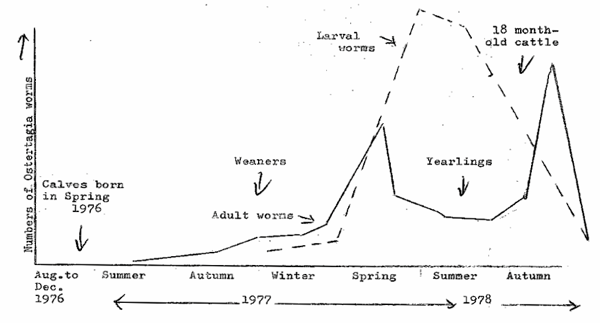
THE SPRING BUILD-UP OF WORMS. (See Diagram 1.)
In Weaned Calves at 10-12 months of age.
In Tableland districts, heavy worm burdens begin to build up in weaners in August and September.
The most important worm is the small Brown Stomach Worm (Ostertagia). This worm, about 1cm long, lives in the 4th stomach and has a brown hair-like appearance. In spring, the stomach lining becomes severely inflamed, thickened and covered with tiny nodules where the worms have burrowed.
At the end of September, some animals may show symptoms of Ostertagia infection - loss of energy, loss of condition and scouring. Even if the animals do not look obviously 'wormy' in spring, they would have still picked up many thousands of Ostertagia worms which are only in the larval stage of development. These larval worms (inhibited larvae) lie dormant in the stomach lining from spring until the autumn in the next year (a dormant period of about 3-6 months).
Research has shown that the enormous intake of these larval worm is a serious set-back to optimum growth rates.
Diagram I
The Autumn outbreak in 18-20 months old cattle - Why?
(See Diagram I.)
In March and April, when the young cattle are 18 months old, masses of dormant larvae in the stomach lining resume development and grow to adult worms. This results in heavy adult worm burdens in autumn of the second year. Thus in autumn (March-April), severe worm outbreaks may occur with many animals showing a profuse watery scour and rapid loss in condition.
WORM LARVAE ON THE PASTURE - The Spring Build-Up. Why?
(see Diagram II.)
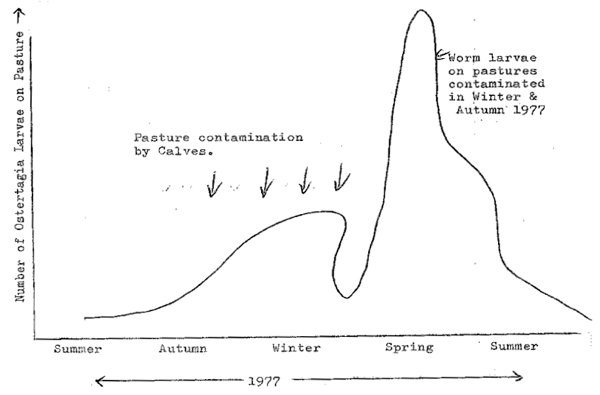
The rapid spring build-up of Ostertagia worms in the weaners is caused by a sharp spring rise in numbers of worm larvae in the pasture.
These massive pasture infestations in spring are always in paddocks which have been grazed by young calves in autumn and winter.
From March to July, thousands of Ostertagia worn eggs are passed out in the dung of apparently healthy calves. These eggs hatch into infective larvae. A few larvae may leave the dung pat immediately and crawl into the grass. However, the winter weather is too cold for movement of large numbers of larvae into pasture. Instead, the larvae survive for many months in the dung pat, even in heavy frosts, snow cover or dry weather.
From late August, massive numbers of larvae quickly build-up on spring pasture. This build-up is associated with warmer weather and early spring rains.
Larval numbers usually fall away rapidly in early summer
Diagram II
SUMMARY CF SEASONAL TRENDS OF OSTERTAGIA WORMS
1. Pastures contaminated by calves in autumn and winter become heavily infested with worm Larvae in spring.
2. The larval abundance on spring pastures results in heavy worm burdens in yearling cattle in spring and summer. This may lead to a 'worm out-break' in spring.
3. Thousands of larval worms also build-up in yearling cattle in spring. Larval worms are dormant for 3-6 months.
4. Larval worms mature to adult worms in 18-month old cattle in their second autumn. This can lead to a second 'Worm outbreak' in April.
WHAT IS THE CONTROL SCHEME?
The important principle to remember - Do NOT graze weaners on pastures which are heavily infested with worm larvae.
Worm control should aim to prevent a build-up of spring worm burdens in the weaners from the 31st July. This can be achieved by using 'Safe Pastures'.
'Safe Pastures' are infested with only small numbers of worm larvae and are prepared by preventing pasture contamination with worm eggs in autumn and winter.
STOP PASTURE CONTAMINATION !
Alternative Management Systems to use between 1st April and 31st July - The Crucial Period.
Step 1.
Graze paddocks with adult cattle - older cattle are more resistant to worms and pass fewer worm eggs,
or
Graze paddocks with sheep
or
Spell paddocks.
These paddocks will now provide 'safe' grazing for weaners in spring.
Step 2
On 31st July treat all weaners with a broad-spectrum drench and move on to the prepared 'safe pastures'. The drench will delay fresh contamination of the 'safe' pastures.
NOTE:
None of the above programmes may be suitable. You may want to graze weaners continuously on the same pasture. Reduce autumn-winter contamination of this pasture by drenching the calves (1) at the end of March and (2) end of May. You will still need (3) the end of July drench for the weaners. This method is now being tested in an experiment at Glen Innes (Northern Tablelands).
The 1976 Control Trial at 'Glenellan', Golspie
In 1976, the control plan was followed, using adult cattle to graze paddocks in autumn and winter.
Weaners (spring-born 1975), which were drenched and moved to these 'safe paddocks' on 31st July did not show any signs of worms at the end of September, but weaners on contaminated pastures were obviously 'wormy'.
In December, some yearlings on the 'safe pasture' showed symptoms. Why?
It is apparent that the 'safe pastures' had become freshly contaminated with worm eggs in spring. Spring weather favoured an immediate build up of larvae from freshly dropped eggs on the 'safe pasture'. At Golspie (and probably in eastern Tableland districts), spring weather is generally cool and wet well into summer and worm larvae will continue to survive for longer periods. We did not allow for this weather pattern in 1976.
The Present 1977 Trial
Designed to combat pasture contamination (1) in autumn and winter by calves and (2) in spring by yearling carry-over.
Step 1. 'Safe spring pastures' were prepared by grazing adult cattle on 4 paddocks from 1st April to 31st July.
Step 2. On 31st July, all weaners were drenched and then moved between 2 'safe' paddocks at fortnightly intervals until 11th October, 1977. The other 2 'safe' paddocks were spelled in August and September.
Step 3. On 11th October, the weaners will be drenched and moved to the 2 paddocks spelled in August and September.
Step 4. In December, 1977, the weaners will be moved back to the first 2 paddocks which had been
(a) grazed in August and September and,
(b) spelled in October and November.
This management system will:
1. Avoid the massive spring pick-up of worm larvae derived from worm eggs dropped in autumn and winter.
i.e. THE BASIC PLAN
2. Avoid late spring pick-up of worm larvae derived from fresh spring contamination.
i.e. The Added Plan at Golspie to Combat the Effect of Spring Contamination.
3. Provide fresh spring feed in spelled paddocks.
4. Require 2 drenches for the year, at the end of July and early October.