ARCHIVE FILE
See the original document
The Epidemiology of Brucellosis in the New England Area and Its Relationship to Decision Making
D.C. Rolfe, B.V.Sc., M.R.C.V.s. Veterinary Officer (Brucellosis) Armidale
The Brucellosis eradication programme in the New England area has arrived at the situation where provisional freedom will be declared during 1979.
In my view the easy part is over. The last 18-24 months have been concerned with logistic matters - employment and training of staff, provision of vehicles and supplies, contact with farmers and testing of cattle. In fact, very little time has been allocated in our thinking to the disease as such. Our concern in this regard centres mainly on the interpretation of serological results, that being an empirical exercise at the best of times.
However, provisional freedom status implies a sense of control over the organism and its host. In practical terms cattle movements are controlled and all infected herds are quarantined and undergoing eradication testing. One of the principal concerns that is emerging in the programme now is the eradication of the disease in certain problem herds.
It has been said that once a problem herd has been thoroughly investigated, it becomes no longer a problem herd. This is not entirely true but certainly a thorough investigation often provides opportunities for constructive action based on valid data.
Such an investigation becomes the province of epidemiology. I have borrowed from 'Epidemiology in Veterinary Practice' by Schwabe, Leinan and Franti a summary of how epidemiology is applied to a practical situation.
'Modern epidemiology rests on the premise that disease in populations does have multiple determinants, and that these determinants usually include one or more specific animate or inanimate agents, as well as factors associated with the host animals themselves and their environment. It follows that in the prevention or control of a disease, attention should be directed to the relative importance of and the ease of approach of all identifiable determinants'.
For the sake of completeness, determinants are 'any variable, specific agent host factor or environmental factor which directly or indirectly increase[s] (or sustain[s]) the frequency of occurrence of the disease'.
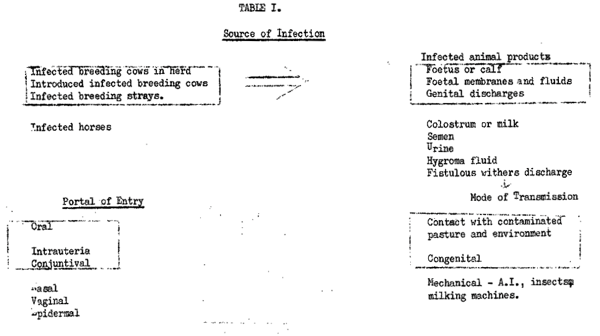
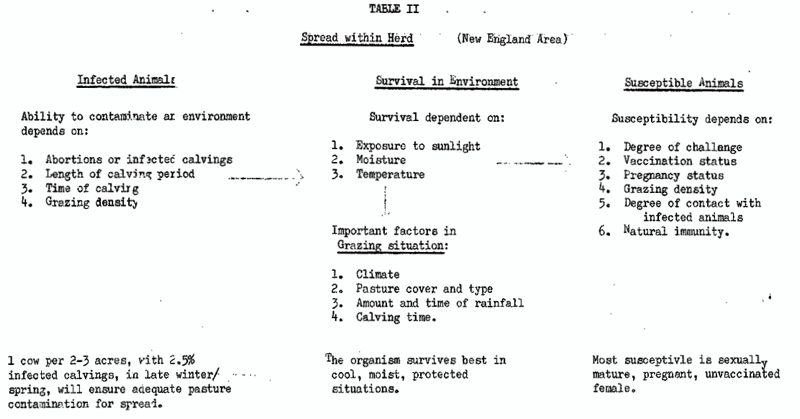
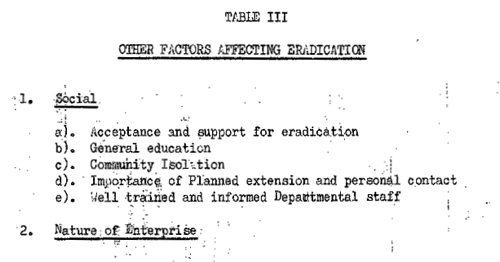
I have attempted to summarise the determinants in bovine brucellosis in the New England area and these are included in Tables I, II and III. You may say that you have seen it all before. However, we all tend to forget it when confronted with a cattle owner with reactors at E5 who is less than happy with the situation.
If I have a point to make in this talk it is that an unwavering commitment to the test and slaughter technique in all herds in your district will result in failure to eradicate in certain herds.
Some of you are deeply involved in brucellosis eradication in your area. You will be confronted with herds where test and slaughter appears not to be successful, and more than likely the owner will make sure you are aware of his situation.
I suggest that when in this predicament you return to first principles. Think of the disease as needing infected animals to contaminate the environment, the environment must he favourable for survival of the organism and there must be susceptible animals. Understand the management of the property, its physical characteristics, the nature of the enterprise and the attitude of the owner. Determine the age distribution and vaccination status of the herd and reactors. Find out the calving period, and relate it to climate conditions and understand the relationship to neighbours.
Action on a particular property may take a variety of courses depending on the information obtained during your investigation, but in all cases action should be the result of a frank discussion with the owner, taking into account good disease eradication principles, and the particular circumstances of the property and the owner.
You will find that owner co-operation will improve markedly when he is involved in the decision making process and understands the difficulties in eradication.
At least half of the problem herds can be attributed to social aspects mentioned in Table III. Whether we like it or not, people own the cattle that are being tested. Keeping the rural community well advised on progress and changes in policy will ensure that at Least they are aware of what is going on. Our field staff are seen by the rural community as the N.S.W. Department of Agriculture. Well trained, enthusiastic and knowledgeable field staff are a tremendous asset and we should aim to establish and maintain such a workforce.
I mention these social aspects because I consider them to be determinants of the disease. You will often find yourself undoing the social mistakes of the past when dealing with a problem herd.
A further consideration is the nature of the enterprise on a property. We have experienced particular problems in areas where cattle are run in conjunction with cropping activities. The latter take priority in the farmer's mind and this can be to the detriment of eradication. Worse, still, cattle on these properties can be heavily infected and be running in a less than controlled management situation.
Another problem property is the extensive one in the Eastern Fall and mountain country. While the owner may be more of a cattleman, his enterprise centres around the harvesting of musterable cattle. Fences and facilities are usually poor and the country makes mustering difficult. Further, this disease often spreads well in this country. Brucellosis in a herd in either of the above situations will not respond to conventional test and slaughter techniques alone.
However, a careful examination of disease history, management practice and the property, coupled with a discussion with the owner, will usually provide a logical basis on which to act. The owner can be given predictions about the future, difficulties in eradication and information about the techniques available. You will be told what his problems are and the limits of his financial and labour situation. Within such an understanding lies the basis to successful eradication.
To illustrate some diverse approaches that have been used in DVO(N)'s area, the following summaries are provided:
1. An extensive property of about 10,000 hectares in S.E. Armidale P.P. District. The property is on the top and eastern side of the Great Dividing Range and the area is in an isolated locality. It is partly developed but on average, it is a difficult property to muster and control. Internal fencing is poor, and boundary fences vary from poor to adequate.
Staffing is inadequate and of dubious quality, except for the manager.
The main enterprise is breeding of cattle - steers being fattened on another company property. The property is overstocked and the quality of weaners produced was poor. The property had run at a financial loss for a number of years. Testing history is summarised below:
| No. Tested | No. Fail | Prevalence | |
|---|---|---|---|
| Whole herd test 1975 | 3261 | 727 | 22.3% |
| E1 1977-1978 | 2622 | 425 | 16.2% |
| E2 1978 | 4673 | 177 | 3.78% |
S19 vaccination has been practised in the past and the result is now that about 50% of the adult herd and about 65% of heifers are vaccinated.
Following discussions with the management the following programme has been agreed to:
a. Cease testing adult herd, which has been largely uncontrolled in the past. Sell for slaughter all non-pregnant adult females. After weaning, spay all calved adult females and sell for slaughter as they fatten.
b. Spay and sell for slaughter all N.V. heifers.
c. Retain S19 vaccinated heifers as nucleus of new breeding herd and contain these on a part of a property where fences are better and facilities for testing are nearby. This group would be tested at regular intervals (about every 3-4 months).
d. Aim to eventually establish a full vaccinated breeding herd of about 2000. It is expected that brucellosis could be eradicated in this group by the end of 1981.
e. The costs involved in this programme are enormous from both the management und Departmental points of view. Consequently this property is being used as the basis of an economic study to investigate the implications of disease control decisions.
2. A dairy herd in the Inverell District, with a long history of Brucellosis.
Testing summary is:
| Date | No. Tested | No. Fail | Key | Remarks |
|---|---|---|---|---|
| 14.11.77 | 179 | 18 | E1 | Long history of Positive tracebacks. As well, property sold and buyer introduced cows from another heavily infected herd. |
| 16.1.78 | 154 | 7 | E2 | |
| 8.3.79 [78?] | 149 | - | E3 | |
| 26.4.78 | 149 | 1 | E4 | |
| 26.5.78 | 154 | - | E5 | |
| 26.7.78 | 242 | 2 | E6 | |
| 26.9.79 [78?] | 253 | 2 | E7 | |
| 3.11.78 | 244 | - | E8 | |
| 6.12.78 | 134 | - | E9P | S19 cattle |
| 17.1.79 | 101 | 27 | E9F | Anamnestic test |
This herd is the second largest supplier in the Inverell district. The sharefarmer managing the dairy was very cooperative although there were considerable personal problems in the partnership. I became interested in the herd at E6, E7 as it appeared to me that test and slaughter wasn't working too well. Examination of specimen advice forms and farm records indicated that about 50% of the herd was vaccinated and all reactors came from N.V. cattle. There appeared to be a low incidence because of spread out calving and that this could be eliminated by reducing the number of susceptible animals and by identifying latent carriers.
Action, following discussions with the sharefarmers, was:—
a. Divide the herd into N.V. and S19 cattle
b. Identify both groups with different coloured flag tags
c. Continue to test S19 group as usual
d. Vaccinate N.V. group with 45/20 and submit blood samples for CFT and ABGT, looking for anamnestic response. Any animal where S19 status was not certain was vaccinated with 45/20. The sharefarmers were advised that previously vaccinated but poorly identified cows would give an anamnestic response and be treated as a positive reactor. Such animals would account for some of the reactors detected on the anamnestic test.
e. It is anticipated that this herd will be out of quarantine in 1980.
3. This was a small property in Tenterfield P.P. district owned by a widow. Her husband had died recently and she was in financial difficulty. The property was poorly developed - fences were poor and the cattle were nondescript. She had no idea on how to make money off the land and even if she did, the finance wasn't available. Testing history was:
| Date | No. Tested | CF+ | CF? |
|---|---|---|---|
| 5.7.78 | 36 | 3 | 4 |
| 9.8.78 | 33 | 1 | 4 |
No CF reaction was greater than CF16. An examination of traceback history revealed no positive traceback to her property, or properties of origin of the cattle.
A check on the history of the CF reactors indicated that all of them were S19 vaccinated, and vaccinated at 9-12 months of age. An important feature was the possibility that most reactors were probably vaccinated when pregnant. The owner was quite proud of the fact that a 3-4 y.o. cow had had its third calf. All the reactors were pregnant.
To confirm the presence or otherwise of infection in the herd, the reactors were sent to slaughter. Foetal membranes, supramammary and iliac lymph nodes were collected by the Senior Meat Inspector, and submitted for laboratory examination. Brucella abortus could not be cultured from any source, and inoculation of guinea pigs was negative.
In my view, the CF reactors had become infected with S19 Brucella abortus on their first pregnancy. That infection was no longer present but antibody response was still sufficient to give an inconclusive or positive result. I consider this herd to be non-infected and should not be subject to eradication testing. Appropriate check tests would confirm or otherwise this opinion.