
ARCHIVE FILE
This article was published in 1979
See the original document
Hereditary Neuroaxial Oedema in Poll Herefords
F.L. Clark, B.V.Sc., M.A.C.V.Sc., Veterinary Inspector, Armidale
Hereditary neuroaxial oedema (HNO) is a congenital disease of calves. It has been recorded in the United States of America (Cordy et al. 1968), in Australia (Blood and Gay 1972) and in New Zealand Davis et al. 1975).
All cases recorded have been confined to the Poll Hereford breed except those described by Davis et al. (1975) which occurred in Poll Hereford Friesian cross cows joined to Poll Hereford Friesian cross bulls, Breeding records had not been kept and thus the authors were not able to determine the relationships between the cows and bulls.
Calves are affected at birth. They are well developed and otherwise appear normal. The calves are unable to stand and generally lie quietly in lateral recumbency. The outstanding clinical sign is hypersensitivity to touch and to a lesser extent sound. A touch anywhere on the body sends the calf into a sudden tetanic spasm. The spasm only lasts a few seconds after which the calf relaxes.
Affected calves are alert and appear to have normal hearing and sight. They will readily suckle from a bottle but obviously cannot survive without assistance. They have been kept alive by bottle feeding for periods up to a month without any lessening of the neurological signs (Blood and Gay 1971).
During 1978 HNO was diagnosed in newborn Poll Hereford calves in a herd in the Armidale Pastures Protection district. Cases had occurred each year over a period of seven years, varying from one to six cases a year except in one year when 14 cases were recorded. The total herd size is approximately 160 breeding cows giving an incidence of 0.5 to 8%.
The herd was originally made up of 82 heifers of one blood line plus other breeders of different blood lines. All clinical cases of HNO were confined to the original 82 heifers and their progeny. During the whole period the bulls used were descended from the same blood line as the 82 heifers.
Subsequent investigations on the parent stud revealed that they had experienced cases of HNO since 1966. The incidence had generally been low and although genetic disease was considered, the owner felt that due to the variability of expression, an environmental factor must be operating. We were fortunate in our investigation that the owner not only kept excellent records but was willing to make these records available without restriction.
From Table 1. it can be seen that incidence of the condition ranged from one case in 1968 to 11 in 1970. During the years 1970-71 the greatest incidence of the condition occurred coinciding with the occasion that the mothers were kept throughout gestation in exposed paddocks. Many genetic conditions have variable expression and the degree of variability can depend on a range of environmental factors including heat (Edwards 1978).
The association of heat during a particular stage of the gestation period was further suggested when we look at the calving distribution of normal calves and those showing clinical signs of HNO. (See Figures 1 and 2). 82% of clinically affected calves during the calving years 1971-77 were born in the first 25 days of the normal calving period. In contrast to this only 42% of unaffected calves are born in this period, suggesting that another factor as well as genetic may be operating. It may be expected that if the clinical expression of the condition were completely under genetic control, affected calves would be distributed 'normally' within the calving period.
In 1972 and 1973 dams which had previously thrown affected calves were rejoined to the same sires and held, not in exposed paddocks as in the previous 2 years, but in sheltered shaded paddocks throughout the gestation period. As can be seen from Table 1 there was an apparent dramatic decline in numbers affected.
To determine if this apparent effect was real or otherwise we examined cases arbitrarily by years
1. In those proven dams prior to 1970, rejoined in 1970 or later to proven carrier bulls there is an incidence of 22.7% i.e. 17 normal calves and 5 affected.
2. In those proven dams prior to 1971, rejoined in 1973 or later to proven carrier bulls there is an incidence of 25%, i.e. 18 normal and 6 affected.
This data conforms with the incidence of 1:4 which would be expected in an autosomal recessive condition (Cordy et al. 1968).
We also examined the temperature records of the Armidale Meteorological Station over the ten year period 1968-78 and were unable to satisfactorily demonstrate that the years in which this condition increased in incidence were associated with extremes in temperature. Thus although the calving distribution date and the changes in husbandry practices were suggestive of heat being associated in the variability of clinical expression, we were unable to confirm this with the data available to us.
The main purpose in presenting this paper is to increase awareness of this genetic condition. As it is an autosomal recessive condition, control in individual herds could be effected by changing blood lines of the bulls. However, this will not eliminate the carrier animal.
For a more complete control it is also advisable to cull any females which have thrown affected calves and their progeny.
FIGURE 1. NORMAL CALVING DISTRIBUTION
STUD A.
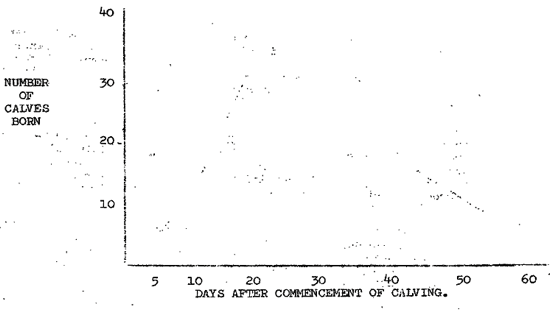
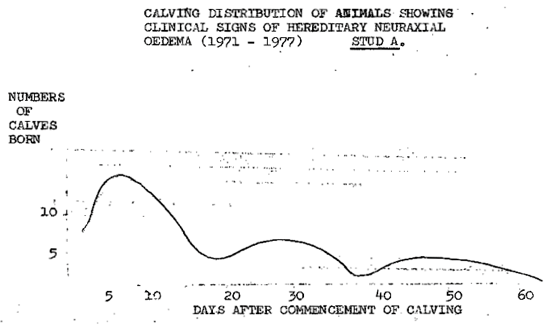
TABLE 1. Numbers of Calves Affected each year with Hereditary Neuroaxial Oedema
Stud A.
| Year | 1966 | 1967 | 1968 | 1969 | 1970 | 1971 | 1972 | 1973 | 1974 | 1975 | 1976 | 1977 |
| Numbers Affected | 4 | 3 | 2 | 3 | 11 | 9 | 2 | 3 | 2 | 3 | 4 | 2 |
TOTAL BREEDING HERD DURING THIS PERIOD (250-300).
REFERENCES:
Cordy D.R., Richards W.P.C. and Stormont C. (1969) Path Vet. 6:487
Blood, D.C., Gay C.C. (1971) Aust. Vet. J.
Davis, G.B.M., Thompson E.J., and Kyle R.J. (1975) New Zealand Veterinary Journal (1975) 23 (8):181
Edwards M. (1978) personal communication