ARCHIVE FILE
See the original document
Dieldrin Residues - an Interesting Case Report
J.M. Wilson, B.V.Sc. Veterinary Inspector, TWEED-LISMORE NSW
This report details an investigation into the presence of dieldrin residues in a dairy herd, resulting from urban encroachment. It discusses some of the problems encountered in dealing with the problem, and preventing its recurrence.
HISTORY
On 24/3/81, a cow slaughtered at Casino abattoir had a dieldrin level of 0.40 ppm. By means of a tail tag the property of origin was identified as a dairy farm at Mullumbimby. The animal involved was a cull dairy animal that had been bred on the property.
Detention Notice Form 1 was issued on 20/5/81. Because all cattle were lactating, and in poor condition, it was not considered practical to carry out fat biopsies.
10 milk samples were taken at random from the herd at milking, and submitted to the Board of Tick Control Laboratory for analysis of milk fat. Dieldrin levels in these samples ranged from 0.20 ppm to 0.62 ppm. The average of the sample was 0.38 ppm.
Detention Notice Form 2 was issued on 16/6/81.
Because the M.R.L. for fat of milk is laid down as 0.15 ppm, concern was felt about the possible risk to humans consuming the milk from this dairy. This matter was raised with the District Veterinary Officer, who in turn took the matter up with the Health Commission and the Dairy Industry Marketing Authority.
It was considered at one stage that the dairy should be prevented from supplying whole milk. However, it was ultimately decided that because the milk would be substantially diluted by mixing with the product from other suppliers at tanker and factory level, the farm would be allowed to continue operations.
Periodic surveillance was continued by the Health Commission, testing bulk milk samples from the herd. The results of these tests are not available.
When it was believed that sufficient time had elapsed to allow the dieldrin levels in the herd to have fallen to an acceptable level, and the owner was anxious to cull some aged cows from the herd, 10 milk samples were collected from individually identified cows selected for culling on 18/2/82.
These returned milk fat dieldrin levels ranging from 0.02 ppm to 0.10 ppm. A bulk milk sample from the vat returned a reading of 0.05 ppm.
Following pregnancy testing of the only two 'fat' animals in the herd, it was decided to cull these for slaughter. Fat biopsy samples, taken on 19/2/82 returned dieldrin levels of 0.06 ppm and 0.14 ppm.
In order to build up further information to support the recommended release from detention of this property, 6 milk samples were taken from cows in early and mid lactation on 10/3/82.
These gave dieldrin levels ranging from 0.02 ppm to 0.07 ppm.
SOURCE OF DIELDRIN
Early in the course of the investigation, the owner pointed out (in no uncertain terms) that he had, several years previously, and at the instigation of the Department of Agriculture, used dieldrin as a pasture dressing to control various pasture pests.
Analysis of soil and pasture samples from a limited number of sites in paddocks available to the herd discounted this possible source of residues.
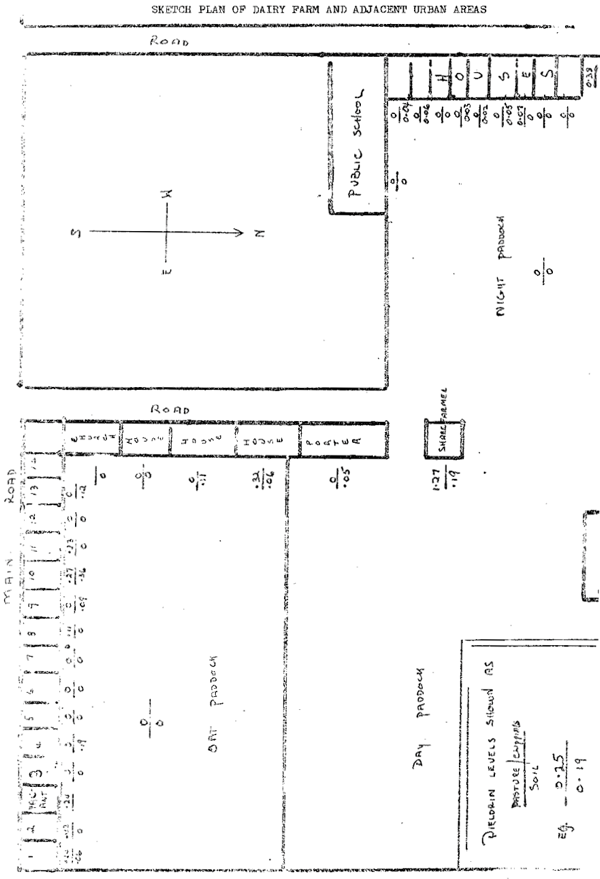
The property is contiguous with many backyards of homes built on blocks sold off the original farm over the years. Many urban dwellers in Mullumbimby have a long association with the Banana Industry, where dieldrin was extensively used in the control of Beetle Borer. A walk around the perimeter of the property indicated that many of the neighbours were in the habit of throwing lawn clippings and garden refuse over the fence into the adjoining paddock. These are tasty morsels to hungry dairy cows, especially when feed is short during dry weather.
Samples of soil, and of pasture or lawn clippings, were taken from the paddock immediately adjacent to each urban property joining the dairy farm. 32 properties were involved, and a total of 65 samples, each individually identified, were presented to the harassed analyst.
Of the 35 properties sampled, 9 gave Dieldrin levels which indicated recent throwing of dieldrin-contaminated material over the fence. A further 11 properties had evidence of similar activity at some time in the past. The remaining properties were negative or had insignificant levels.
ACTION TAKEN
Because of the ample evidence of mis-use of dieldrin, and because Veterinary Inspectors have no powers under the Pesticides Act, it was decided to enlist the assistance of the Regional Pesticides Inspector to interview the offending householders. Regrettably, despite telephone calls and personal interviews with that officer, and numerous requests through the District Veterinary Officer and the Regional Director of Veterinary Services, the desired action has not as yet been taken.
The Regional Executive were then asked to consider, and pronounce, on the following questions:
'What action should the Department of Agriculture take to ensure:
1. that neighbouring urban property owners are made aware of the Pesticides Act? and
2. that neighbours are made aware of their contribution to the dairy farmer's problem, and their legal liability if the operation of the dairy is terminated because of residues?'
These questions were put approximately four months ago. At this stage, no information has been received.
FUTURE ACTION
Sufficient information has been collected to justify the release of this herd from detention on milk fat levels and this has been recommended.
Because of the close correlation between milk fat and body fat levels, policy should allow District Veterinary Officers to release dairy herds from detention on milk fat levels alone. In the case described, until the Department decides to take a more active role in dealing with the source of contamination, the risk of recurrence will be high, especially if dry periods are encountered.
CONCLUSION
Because of urban encroachment, I believe that more cases of this nature will manifest themselves. There appears to be a good case for giving Veterinary Inspectors some powers under the Pesticides Act, so that they can deal with potential sources of contamination on an ad hoc basis, during the course of investigations into residues.