
ARCHIVE FILE
See the original document
Cobalt Deficiency of Cattle
P.L. GREENTREE, Veterinary Inspector
During late summer 1984 I was called in to investigate an illthrift problem severely affecting at this stage some fifty ex six hundred cattle. The animals were 15 months to 2 years of age, being steers with the odd 'mickey' bull. They were Hereford or Hereford Brahman cross. The animals had been introduced from the owners Queensland holdings (Injune, Dirranbandi) as weaners. It was interesting that the females on the property appeared in quite satisfactory condition.
Despite a lush availability of feed these animals were poor, rusty coated and not the ones you would want in your front paddock. My immediate reaction was - 'copper deficiency'. I went further and said 'don't go looking for some mystery disease such as cobalt deficiency'.
The property is situated approximately 40 km north east of Tenterfield at Wilson's Downfall. It is thus on the edge of the granite belt and comprises 1538 hectares. The land has been highly pasture improved over a 15 year period. The fertilizer usage being superphosphate at 125 kg/ha annually with the trace element molybdenum added every three years at 50g/ha. Pasture species now include a legume component dominated by white clover (Trifolium repens) and introduced grasses notably Phalaris (Phalaris tuberosa) and Perennial ryegrass (Lolium perenne). Paspalum (Paspalum dilatatum) is naturalised.
One was struck, on entering the property, by the manner in which the cattle had stripped the bark from the trees.
On this initial visit I autopsied a poor conditioned anaemic 18 month old steer and submitted samples to the R.V.L. Armidale. Significant results being a P.C.V. of 25% and a blood copper level of 45 µmoles/l. (Normal > 11 Deficient < 8). This certainly put a gloom over my copper theory.
The problem continued and a second visit eventuated. Four more animals had either died from misadventure or had been destroyed.
Another animal was destroyed and autopsied. Grossly the main features were anaemia, emaciation and a jaundiced carcase. The R.V.L.'s significant findings were a P.C.V. of 23% and 'clear' microscopic evidence of liver damage suggestive of a plant poisoning.
This animal's serum copper was 22 µmoles/litre. Five blood samples from his mates gave copper levels of 30, 34, 57, 43 and 17 µmoles/l. The results certainly laid to rest any suggestion of copper deficiency.
Now my attention was switched to a plant survey for toxic species. Seven potentially toxic plants were identified by the Botany Department, University of New England. None were sufficiently toxic nor widespread on the property to be seriously considered the primary cause of the problem. At this time a history of soil samplings was also submitted to the R.V.L. along with a lot of questions and a plea for answers. There was also a renewed offer to deliver five animals live to the R.V.L. for 'in depth, on the spot examinations'.
I feel the thought of a load of cattle landing at the R.V.L. prompted the dispatch northward of Mr. Ian Duncan.
On our visit the owner had yarded about 40 illthrifty steers. It was early winter and we selected ten from the mob as being severely affected.
All were clinically poor in condition with rough rusty coats and sporting a population of sucking lice. All ten steers were blood sampled. No. 10 which was to the staggering stage was destroyed and autopsied. Naturally the carcase was emaciated, but unlike his predecessor no jaundice was evident.
A noticeable feature was the rumen being practically devoid of content.
This was to assume importance in retrospect.
Still with the possibility of liver damage in mind serum AST (formerly GOT) levels were assessed. Eight out of ten were within the normal range and the remaining two very slightly elevated.
Serum copper levels were again tested and ranged from 10.2 µmoles/l to 15.6 µmoles/l and must be considered normal.
Total serum proteins were low, average = 57.1 g// (Normal > 65g/l). Serum albumin was also low, average = 28.5 g/l (Normal > 30 g/l).
Haematology confirmed the clinical anaemia. PCV's ranged from 19% to 39% with an average of 22.5%. Our staggery No. 10 naturally was on the 19%.
More detailed haematology showed the anaemia to be normocytic and normochromic and surprisingly non-regenerative.
Total white cell counts tended to be low/normal and in those 4 samples on which differential white cell counts were done there tended to be low numbers of neutrophils and low/normal numbers of lymphocytes.
Histological examination of tissues from animal No. 10 showed evidence of considerable Red Blood Cell breakdown in the spleen. There was no extra-medullary erythropoiesis and while bone marrow did show some erythropoietic activity it was considered less than normal.
Plasma was dispatched interstate for Vitamin B12 estimations. The Vitamin B12 radio-assay procedure was that described by Judson et al. (1982). Results showed a mean Vitamin B12 concentration of 154 pico moles/l with only three samples being within the normal range i.e. > 200 pmoles/l.
We prevailed upon the local District Agronomist to have some pasture trace element analysis carried out. Results were not exciting and the trace element we were mainly interested in namely cobalt was conspicuous by its absence.
The stage was thus reached whereby Cobalt deficiency looked to be the cause of the problem. The literature states:
(1) that Cobalt deficiency is a disease of ruminants expressed only as illthrift and death, if it occurs is due to inanition (Refer - autopsy of steer showing rumen practically devoid of content).
(2) The disease is characterised by a gradual reduction of appetite for both food and drink, progressive emaciation and death from starvation even though food may be plentiful (This certainly applied in our situation).
(3) The European name 'Licking Disease' places emphasis on allotriophagia (depraved appetite, pica) that accompanies inappetence (NB. Bark off trees. Our liver damage in the animal that prompted the plant survey).
(4) Anaemia due to lack of Vitamin B12. (Again fitting our results).
(5) Granite derived soils are known in some areas to be deficient in Cobalt. (as above).
(6) It has been suggested that leeching of the trace element occurs quite readily. (This property has an average rainfall of 44 inches over a 14 year period. In 1983, 65.35 inches were received and initial clinical signs developed in 1984).
(7) The minimum concentration of cobalt in fodder consistent with adequate nutrition of ruminants is 1 ppm on a dry-weight basis, but the only effective test of cobalt deficiency is in the response to supplementation. There are certainly limitations to the diagnosis based on blood and tissue samples.
Ian consulted Dr. Keith Ellis C.S.I.R.O. Armidale who has been involved in the development of Intra-ruminal Controlled Release Devices (C.R.D.) for both sheep and cattle. He was impressed with the history presented to him and willingly contributed his expertise and C.R.D., to a small trial. We are deeply indebted to him and C.S.I.R.O. as without their help this trial may never have got off the ground.
The C.R.D. are a synthetic cylinder approximately 5" long and 1¼" in diameter. They contain a base material in which is suspended the trace element or product you wish to deliver. This material is forced by a spring apparatus towards the opposite end through which it is released. Depending on the concentration of the mixture and the tension of the spring a calculated dose can be delivered for a given period of time. The cylinders are fitted with wings which open up and prevent their regurgitation. The C.R.D. is administered by a balling gun device.
Dr. Ellis prepared the C.R.D. for a daily release of 10 mgm Co/day as CoCl2.6H20 (keeping in mind the said requirement of 1 ppm dry matter basis).
From data gathered from C.S.I.R.O's, fistulated cows the devices were designed to last for 90 to 100 days.
In November 1984 our trial was commenced. Twenty steers 25 to 28 months old were weighed and allocated, using a restricted randomisation procedure, to treatment and control groups so that the mean body weight of each group was similar (343kg). All cattle were treated for internal and external parasites and run as a single mob. They were re-weighed at approximately 3 weekly intervals on 4 subsequent occasions. Results are summarised in Figure 1.
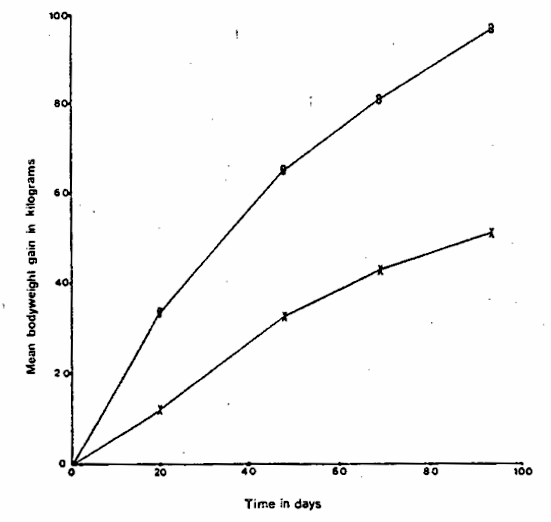
There was a marked improvement in the general appearance of the treated cattle and in their weight gains as early as 20 days after treatment. Over 94 days the mean weight gain of the cobalt treated group was 97±21 kg compared with 52±24 kg for the control group.
Conclusions: Clearly a response to Cobalt supplementation was obtained.
We feel that:
(1) The deficiency of cobalt has been induced by years of superphosphate treatment and pasture improvement. i.e. the animals have harvested the limited supply of the trace element.
(2) This illthrift problem was triggered by the wet year of 1984.
What were the options to overcome the problem[?]
(1) Pasture supplementation via fertilizer using ½ Kg CoS04/ha annually or 1½ Kg/ha every 3 - 4 years - very expensive and not always successful.
(2) Use of C.R.D. - These are not commercially available.
(3) Co containing licks or blocks - inherent problems of low Co content and animal intake.
(4) Vitamin B12 injections.
In late April 1985 we commenced a second trial on this property using steers aged approximately twenty months. These animals appeared to be in good health. Three groups were allocated in similar manner as for trial 1, They were Control, C.R.D. and Vitamin B12 * Injection.
Results are summarised in Figure 2.
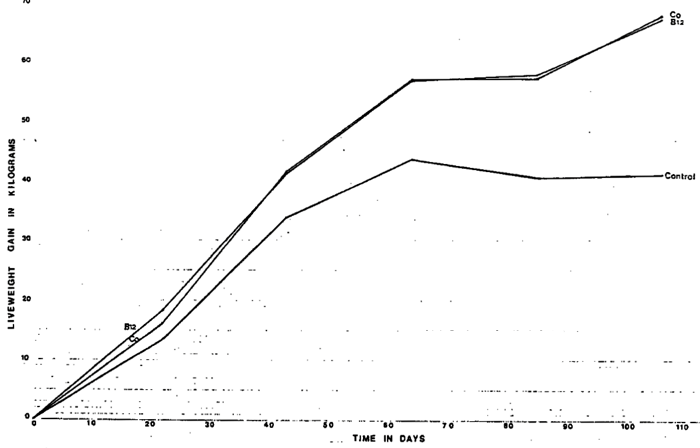
After 106 days the C.R.D. and B12 Groups had an advantage of 25 Kg over the controls.
We would therefore suggest that injection of this product is the way to go. At the moment an Adult dose costs approximately 36¢.
I would like to thank Mr. Ian Duncan and Dr. Keith Ellis and their associates for their excellent contributions. To me it has been a very rewarding experience. To the property owners, Mr. & Mrs. J.D., it has been financially very, very rewarding.
This project I feel highlights a co-operative effort between three Organisations' staff, namely P.P. Board, Departmental and C.S.I.R.O.
References
Judson, G.J., McFarlane, D.J., Riley, M.J., Milne, M.L. and Horne, A.C. (1982) - Aust. Vet. J. 58 : 249
Peter, D.W. and Ellis, K.J. (1981) - Proceedings of the Nutrition Society of Australia 6 : 146
E. A. Campbell (1983) Nutritional Deficiencies and Diseases of Livestock Vol. 3:198
JUBB K.V.F., KENNEDY PETER C., PALMER NIGEL - Pathology of Domestic Animals 3rd Ed. 1985 Page 130
* Heriots Vitamin B12 Injection. Heriot Agencies Pty. Ltd., 16 Macquarie Place, Boronia, Vic.