
ARCHIVE FILE
This article was published in 1986
See the original document
Selenium Deficiency in Dairy Cattle in the Denman-Singleton Pastures Protection Board
By M.J. Emms, Veterinary Inspector, Denman/Singleton
INTRODUCTION
In the Denman-Singleton Pastures Protection Board area many Dairy farmers have had problems with fertility, in both cows and heifers. The fertility problems in cows tend to be seasonal with the main problem period being late summer, autumn and early winter. Cows in herds experiencing problems show:
i. First Service Non Return Rates falling to as low as 20%.
ii. Increasing calving to first heat period intervals. These may be as high as 120 days or more.
iii. Excessive numbers of services per conception.
In some of the herds where we have seen these fertility problems we have also had increases in the number of cases of clinical and subclinical mastitis during the problem periods.
In heifers we have lowered fertility which is usually seen as heifers failing to conceive before 30 months of age and also poor growth rates in many cases.
These problems have been on Dairy farms in the area for some years and have been investigated in most cases with no result.
In late 1984 following work in the Maitland area with Selenium, Ian Lean BVSc of Singleton looked at the possibility of Selenium being part of the problem. In May 1985, I became involved in the problem and since then we have made field observations and collected data which we are not sure of the significance as yet.
PRESENTING PROBLEM
To date we have looked at approx. 35 herds in the area using Blood Glutathione Peroxidase Levels as a measure of Selenium. Typical results of blood levels can be seen in the accompanying table below.
Also listed are the milk Selenium levels from the survey done by the Department of Agriculture in the Winter period of 1984 for each herd.
| OWNER | GSHPx | MILK SELENIUM Winter 1984 |
|---|---|---|
| Boydell | 50-5 (38-63) | 156-3 |
| Stacey | 51 (35-80) | 169-5 |
| Barlin | 30 (15-49) | 123-5 |
| Burns | 32 (13-57) | 98-5 |
| Cheetham | 26 (10-36) | 115-5 |
| Jawimu | 37 (32-40) | 217 |
Further investigation of these herds over a four month period when the owners claim they have problems show First Service non-return rates which vary from 30-50% with typical figures listed below.
| Herd Investigation | FARM 1 | FARM 2 | FARM 3 | |
|---|---|---|---|---|
| Cows | Heifers | |||
| % 1st Service Non-Return Rate (over 4 months) | 39 | 40 | 33 | 48 |
| AV Glutathione Peroxidase in Blood (GSHPx/gHB) | 26 | 22 | 33 | |
| Winter Period 1985 | (10-46) | (2-89) | (13-57) | |
| Milk Selenium Values (Winter Period 1984) | 115.5 | 123.5 | 98.5 | |
Also of note in these herds is that cows returning to service do so on many occasions (8-10 times) with regular (18-24 day) heat periods.
The histogram below shows the distribution of heat periods of one herd over a six month period and an average Glutathione Peroxidase level of 26 u/gHb.
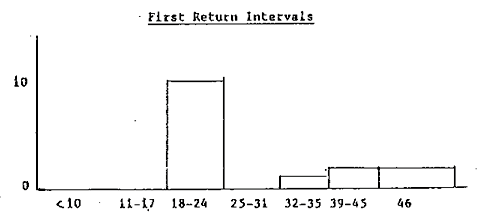
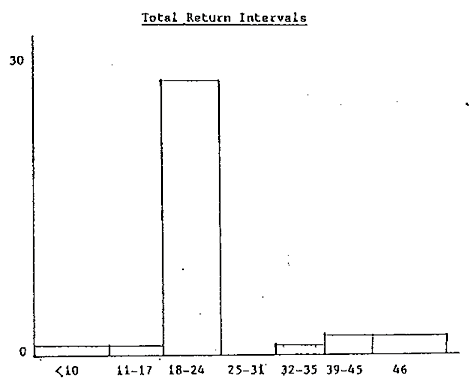
It is of note that all these farms occur on the alluvial river flats and are being fed reasonable quantities of grain in the bails.
TREATMENT APPROACH
Once we have established that a herd has a fertility problem in cows and low Glutathione Peroxidase levels we are adding a premix containing selenium to the grain fed in the bails.
SELENIUM SUPPLEMENTATION PRE-MIX
One kilogram of Pre-mix contains:
| Vitamin A | 5 x 10⁶ IU |
| Zn | 40.0 g |
| Fe | 16.0 g |
| I | 0.5 g |
| Se | 0.2 g |
| Vitamin E (tocopherol) | 7.5 g |
| Vitamin D3 | 333 333 IU |
| Mn | 21.0 g |
| Cu | 4.0 g |
| Co | 0.2 g |
| Orthoxyquin | 0.2 g |
Selenium is included in the form of Sodium Selenite and is provided at the level of 0.2 ppm per kg of grain in mix fed and is supplied in 1.5 kg bags in order to meet with the requirement for a 1.5 tonne mix-all ration formulation.
Follow up monitoring is carried out over the following months and as can be seen from the results below we have obtained marked changes in Glutathione Peroxidase levels.
CHANGES IN GSPHX LEVELS WITH SUPPLEMENTATION
| PRE SUPP | 4mth POST SUPP | |
|---|---|---|
| Farm 1 | 39 (30-51) | 102 (64-142) |
| Farm 2 | 29 (16-41) | 88 (69-109) |
| Farm 3 | 33 (15-69) | 92 (67-115) |
At the same time we have tried to look at fertility changes within the herd.
The graph below shows the changes we have observed in First Service Non Return Rates in one herd.
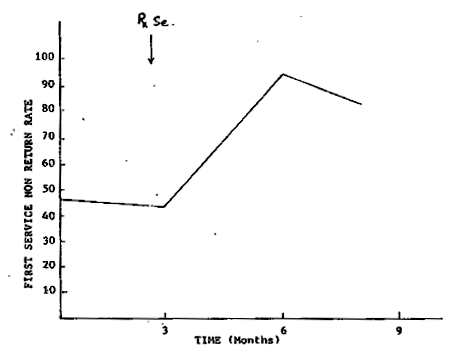
As can be seen in the graph we have had a marked increase in First Service Non Return Rates in the five months following supplementation.
The total number of services per conception in this herd prior to supplementation was 2.84 and post supplementation 1.15.
Below are listed the results obtained in another dairy where no changes were seen in First Service conception rates and Total Service Conception rates but significant changes were seen in the calving to first heat/served 60 day figures and the ratio of 18-24 day heats as opposed to 39-45 day heats.
| SIGNIFICANCE | PRE SUPPL. | POST SUPPL. | |
|---|---|---|---|
| Glutathione Peroxidase levels | 39.8 | 102 | |
| % 1st Service Conception Rate | NS | 42.5 | 47.5 |
| % Total Service Conception Rate | NS | 40 | 38.8 |
| % Cows on heat/Served < 60 days | 0.01<p<0.05 | 56.1 | 81.55 |
| Ratio 18-24 day heats v 39-45 day heats | p<0.01 | 6.3 - 1 | 12.7 - 1 |
SELENIUM PELLET TRIAL
A trial has been established on one Dairy Farm in heifers where we have poor growth rates and lowered fertility using Intra-ruminal Selenium Pellets (Tri-sel - Arthur Websters contains 0.5 gm Elemental Selenium). The First Service Non Return Rate for heifers on this property at the commencement of this trial was approx. 23%.
In this trial we have taken a group of 14 approx. two year old dairy heifers and divided them into three groups, the first group of five was given one selenium pellet, the second group of five were given two selenium pellets and the third group of four were kept as controls. This trial commenced on 2 September 1985 and we have monitored Blood Glutathione Peroxidase levels at monthly intervals. The results can be seen on the graph below.
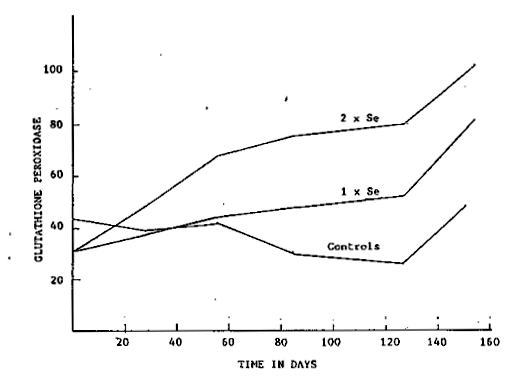
Those heifers receiving two selenium pellets have shown a marked response over the controls where as the response from one pellet has not been as great but is improving.
299 This trial has been in progress now for six months and will be continued for a further six months.
CONCLUSION
It appears that many herds with fertility problems have low Blood Glutathione Peroxidase levels which may be corrected with Selenium Supplementation either as a feed supplement containing (Selenium Selenite) or with intra ruminal pellets containing Elemental Selenium. The results to date are all field observations and require further investigations to be carried out.
REFERENCES
Lean, I J (1985) Supplementation of Dairy cows in the Hunter Valley with a premix containing Sodium Selenite. Proceedings of a meeting on Selenium and Ruminant Health.
Raywood D (1985) Field Observations of Blood Selenium Levels and Fertility in Maitland Pastures Protection Board. Proceedings of a meeting on Selenium and Ruminant Health.
McClure T J (1985) Selenium/Vitamin E Responsive Diseases in Cattle. Proceedings of a meeting on Selenium and Ruminant Health.