
ARCHIVE FILE
This article was published in 1992
See the original document
Dieldrin Residues in a New Commercial Dairy
Robert North, District Veterinarian, DUBBO
SUMMARY
Advisory staff should be aware of the potential problems of commencing a new enterprise in an area previously used for some other purpose. North Coast DV's will be well aware of this due to previous investigations. However it is evident with a trend of dairies to move to more affordable land west of the ranges, that residue monitoring prior to commencement would be a useful recommendation,
INTRODUCTION
This report summarises the investigations into excessive levels of dieldrin being detected in a commercial dairy at Geurie, 25 kms south of Dubbo. The property was purchased in February 1991, a new dairy parlour constructed, and a dairy herd of 130 Friesian milkers transferred from a Gerringong farm to commence milking in July.
INITIAL DETECTION
Detection of dieldrin in a tanker from the Dubbo ACF factory picking up 3 dairies led to the individual farms being sampled on 11th September 1991. A level of 0.25 mg/kg was detected in the milk from one of the dairies. A property visit was made on Friday 13th September by Mr Alex McIndoe, Dairy Corporation, Orange; Scott McKinnon, Inspector (Ag & Vet Chemicals), NSW Agriculture, Wellington and myself.
At this visit,
a. the dairy owners were informed of the high level of dieldrin;
b. the dairy owners were advised that their milk would not be picked up until the level dropped below the MRL (.15 mg/kg);
c. a milk sample was collected to check the validity of the initial detection;
d. soil and feed samples were collected to identify the source of the chemical;
e. A Form 1 Detention under the Stock (Chemical Residues) Act was issued;
f. The owners were advised of the circumstances, possible outcomes, projected time span and actions to take to prevent further contamination.
The owners seemed to be quite philosophical about the situation, albeit disappointed, and very receptive to advice offered.
IDENTIFICATION OF SOURCE.
The immediate suggestion was that the source was soil in the laneways leading to the dairy and the holding yard where cows gathered after leaving the milking parlour.
The dairy is newly constructed and opened in early July. It was built on the site of an old shearing shed. The yards included a circular shower dip, remains of a jetting race, a drafting race and odd concrete pads and timber posts. The perimeter fence was of timber posts. The remains of the shearing shed, numerous posts and sheets of iron, were stacked adjacent to the holding yard.
The property had been bought in February and the dairy constructed since then. Advice from the Dairy Corporation (Mr Col Keith) and NSW Agriculture (Mr Hayden Kingston) on the actual location of the dairy had been utilised. It was suggested that the use of existing yards would reduce building costs.
There was ample evidence of the cows grazing very close to the fence and posts, and the relics of sheep handling devices. It was surmised that prior to the cows being brought to the dairy in July, that a period of having no stock in these yards had allowed quite considerable amounts of plant growth. This had now been consumed by the cows whilst being in the holding yard.
It was later confirmed by contact with the previous owner that dieldrin (and lots of other chemicals!) had been used through the shower dip, and jetting race to control external parasites on sheep; and in the shearing shed and yards as a white ant treatment.
There were levels of dieldrin detected in every soil sample submitted from the holding yard, and along the laneway leading to the paddocks.
Two sources of grain being fed were sampled, with results of .019 and <.005 received, considered to be insignificant.
MONITORING
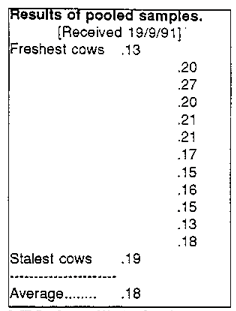
Samples were retrieved from herd recording collections on 12th September, pooled in groups of 10 cows according to stage of lactation and tested for dieldrin.
Forty cows (those less than or equal to .15) were separated to milk into a 'pick-up' vat whilst the other ninety into a 'rejection' vat. Monitoring of both vats continued. Rejected milk was initially poured down the sullage pit to be pumped out with the effluent. Later a mobile vat was supplied by the Dubbo factory and the milk was pumped out over suitable paddocks.
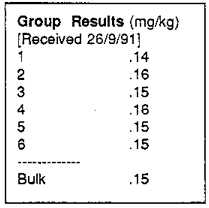
On 23rd September, samples were collected from the ninety 'rejected' cows, on the basis of order-of-milking. Six groups of fifteen cows were sampled.
These results were received on 26th September, the same day that the continued sampling of each vat revealed levels of .08 mg/kg in the 'pick-up' vat, and .11 in the 'rejection' vat.
All milk could again be picked up.
Confirmation of the falling levels was obtained from samples collected on the 28th September, when results of .09mg/kg for the 'pick-up' vat, and .08mg/kg for the 'rejection' vat were recorded. The milking into one collection vat only was then resumed. A vat sample collected on 30th September revealed the level had fallen to .08mg/kg.
Thirteen days production had been affected. Ninety cows had MRL for milk is 0.15 mg/kg been rejected for the full 13 days, whilst forty cows production was rejected for 8 days.
Quota is 11,320 litres /week. At present milking approx. 14,000 litres / week. Quota milk price 44c/l. Surplus 21.5c/l.
PREVENTATIVE ACTIONS.
The immediate action was to not hold the cows in the suspected contaminated holding yard. They were let out immediately after milking. After 2 days of this, the holding yard was cleaned of the remains of the jetting race, concrete pads and posts etc, and an electric fence constructed around the inside perimeter of the holding yard. All signs of vegetation was sprayed with herbicide, although access was restricted by the hot wire anyway.
SUMMARY
I do not believe that any further excessive levels of dieldrin will be recorded at this property. Suspect sites have been sampled, the location of dieldrin residues are known, and permanent fencing and avoidance can be achieved.
It was pleasing to see the rapid rate of fall in the levels of dieldrin in the milk. A short period of intake (2 months) of contaminated soil is presumed to be related.
There was immediate benefit from the group samples, retrieved from the herd recording samples, as this enabled 40 cows to be immediately cleared, and gave a boost to hopes of early resolution. It was not possible to get individual cow samples tested at Dairy Corp lab, due to the numbers of cows involved.
The rapid turnaround time of test results was pleasing, and the Dairy Corporation Lab are to be congratulated for their efforts in this respect.
A number of colour slide photographs were taken around the dairy and yards and are held at this office.
RECOMMENDATION
I believe that the key lesson to learn is the prevention of other violations in new dairies. There is a reported tendency for dairymen from the coastal areas to be moving to traditional sheep areas where affordable farms can be purchased.
The possible location of chemical contaminated areas, yards etc needs to be investigated prior to construction of a dairy and introduction of the milking cows.
These dairy farmers were caught in a regulatory episode through no fault of their own. Every effort should be made to ensure there is no repeat of similar episode.