
ARCHIVE FILE
This article was published in 1992
See the original document
Mycotoxicoses in the Young District
J Evers, District Veterinarian, Young
This paper will briefly discuss the following syndromes seen in the Young District 1986 - 1991 and epidemiological aspects.
The data base is 80 clinical incidents (approx. 3% of record disease incidents) recorded on Vetlink over that 6 year period.
LUPINOSIS
PHOTOSENSITISATION
MYCOTOXIC HEPATOPATHY
STUBBLE POISONING
HYPOPROTEINAEMIA
FESCUE FOOT
Other conditions discussed will include:
CALTROPS POISONING
ALGAL POISONING
PYRROLIZIDINE ALKALOIDOSIS
RAPE SCALD
MOULDY FEED
ACORN CALVES
1. LUPINOSIS
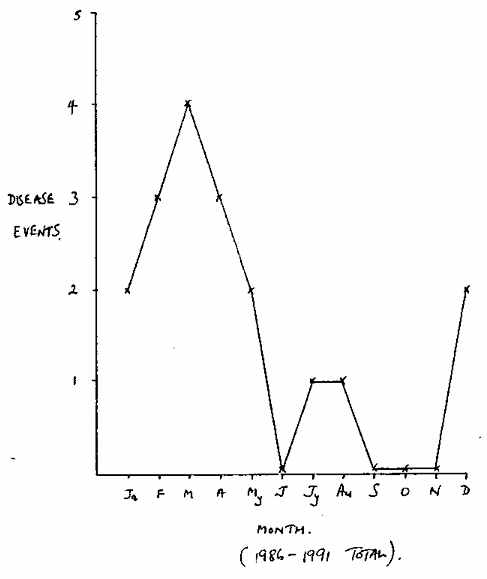
This presents a typical syndrome and has caused heavy mortalities - generally in late Summer and Autumn in sheep and cattle, over recent years this has been offset by widespread use of Phomopsis - resistant varieties; earlier grazing and lock-up; and closer observation of stock.
2. PERENNIAL RYEGRASS STAGGERS
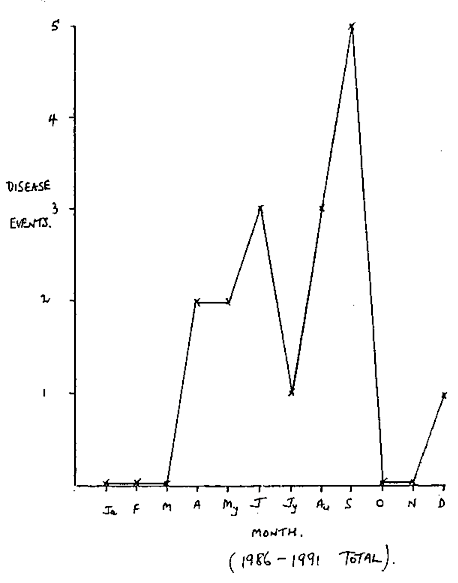
Perennial Ryegrass has been sown into improved pastures east of Young but is generally a minor component of available feed. Unlike other areas, the staggers syndrome tends to occur in Autumn/early Winter and Spring - rather than on Summer rain. Morbidity is low in affected flocks (sheep only) and mortality rare.
3. PHOTOSENSITISATION.
This syndrome is seen at low morbidity but relatively high mortality in sheep and cattle throughout the year. Peak incidence occurs on Winter cereal forage crops - particularly Oats. Outbreaks have been seen on Millet, Pea stubble, Annual Summer grasses (e.g. Panicum sp.) and even Wimmera Ryegrass. Mouldy hay is frequently associated with small outbreaks in cattle. Other potential sources quoted in the literature - e.g. Algae, Patterson's curse - are not incriminated.
All outbreaks are considered to be secondary/hepatogenous and occur on crops and pastures generally grazed with impunity. Because of this, I suspect Mycotoxin activity is implicated and work done on Tribulus Photosensitisation (GeeldiKopp) supports this view. Interestingly, although Tribulus infestations are seen over small areas on many properties, I have never seen Geeldikopp at Young.

4. MYCOTOXIC HEPATOPATHY.
An acute syndrome - excluding Lupinosis - is seen occasionally in mature sheep on dry Summer pastures and crop stubbles. There is a high case fatality rate and low morbidity. Photosensitisation is not associated but on one occasion H/P was suggestive of Facial Eczema.
5. STUBBLE POISONING.
An intriguing syndrome has been observed in sheep on cereal stubbles in very wet Summers. Initially diagnosed as Lactic Acidosis despite the absence of significant quantities of cereal grain in the gut. This disorder is associated with acute scouring, collapse and rapid death.
Laminitis is not observed. Weather-damaged grain is evident in these stubbles.
6. HYPOPROTEINAEMIA
For want of a better name, a syndrome in mature sheep characterised by sudden (1-2 weeks) onset of weakness, S/C oedema and apparent anaemia after Summer rain on dry standing feed. Morbidity is high, mortality low. Initially diagnosed as nutritional, I have tended to revise my thoughts because it is infrequent and sporadic and in one case was associated with mild jaundice (but no hepatopathy on H/P.)
7. FESCUE FOOT
For interest sake - I've only seen one case - 2/800 Merino wethers on Tall Fescue on June, 1989 (a very wet and mild Winter).
8. RAPE SCALD
Minor scaling of the ears is seen frequently in lambs grazing Fodder Rape in early Summer. I presume this is Hepatogenous Photosensitisation associated with Brassica Toxins and not Mycotoxic in origin.
9. MOULDY FEED
As indicated, Photosensitisation has regularly occurred in small no.'s, of cattle fed out obviously mouldy hay. Milk drop syndrome has been seen in a local dairy with purchased grain (not Hyperthermia) after a wet harvest season; egg drop syndrome has occurred on several occasions in large layer sheds under similar circumstances.
10. EPIDEMIOLOGY
I decided to review seasonal occurrence of possible Mycotoxic disorders following unusual observations during the very dry Summer and Autumn of 1991. The subsequent outbreak of Acorn Calves was further incentive as it became evident that a retrospective diagnosis would be required.
This period was characterised by very low rainfall and outbreaks of some of the syndromes previously discussed. i.e.:
1. RAINFALL
The driest Summer/Autumn for many years.
RECORDED RAINFALL - OCT/APRIL 153.3 mm
AVERAGE RAINFALL - OCT/APRIL 364.0 mm
i.e. 42% of normal rainfall.
2. REPORTING OF EPISODES
22-24/1/91 | 20 mm rain.
8/2/91 | Weakness in 50/1,000 Merino wethers.
15/2/91 | 4 mm rain.
18/2/91 | Mortality in 16/420 Merino weaners on hay.
27/2/91 | Weakness in 250/500 Merino ewes.
27/3191 | H. | Mortality in 30/700 Merino wethers on Serradella stubble.
30/3191 | 12 mm rain.
4/4/91 | H. | Lupinosis in 6/200/800 Merino sheep.
5/4/91 | H. | Mortality in 12/20/2,200 Merino wethers on Triticale stubble.
8/4/91 | Scours/mortality in 5/40/200 Xbred ewes on Triticale stubble.
8/4/91 | Weakness/jaundice in 10/70/3,700 Merino wethers.
9/4/91 | H. | Lupinosis in 4/400 Merino wethers.
15/4/91 | 7.5 mm rain.
9/5/91 | H. | Lupinosis in 300/600 Merino sheep.
(H. = Hepatopathy).
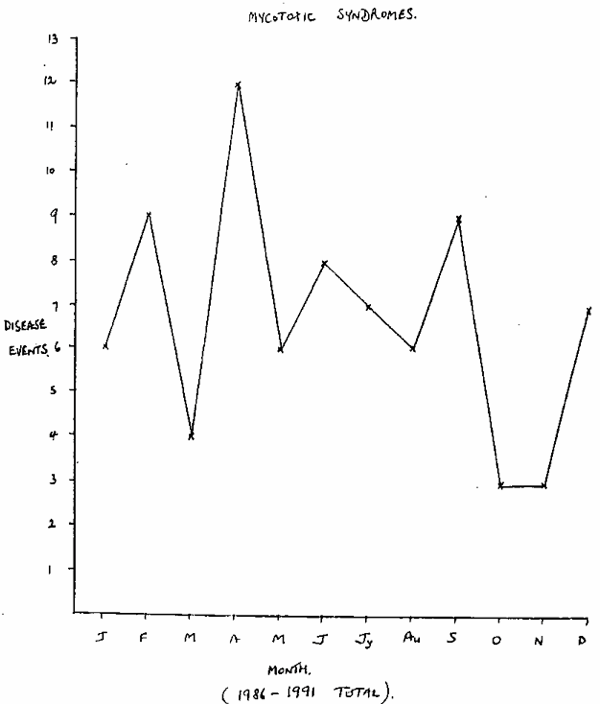
Consideration of all these 'related' disease events by seasonal occurrence is not, of course, very instructive. The only conclusion is that mycotoxic activity is essentially non-seasonal. When you consider that Fungi are adapted to conditions ranging from Arctic to Tropical that shouldn't be surprising
Consideration of total annual events in relation to total annual rainfall is also uninspiring, However, there does appear to be some correlation with low Summer/Autumn rainfall - as observed in the field during early 1991 -and total annual occurrence of these syndromes.
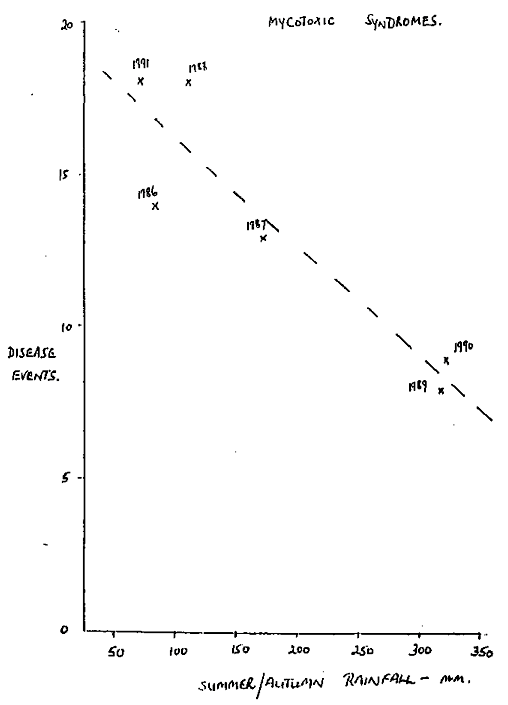
So, presuming there is some increased exposure to mycotoxins at pasture during and after dry Summers/Autumns - how might this be explained? I would suggest the following sequence of events:
i. dry pasture litter provides a good substrate for Fungi to develop on over Summer. Only small amounts of moisture are required to stimulate growth/toxicity.
ii. in most years at Young there is sufficient rain to ensure fairly rapid physical/microbiological degradation of dry feed and litter. This may also provide alternative feed (green pick) and render the weather-damaged dry feed less palatable.
iii. in high risk years livestock ingest more mycotoxic material due to enhanced palatability and/or increased fungal infestation of dry pasture.
iv. in drought years there is inadequate residual litter available for fungal proliferation.
This scenario would tend to maximise seasonal mycotoxic challenge February to April. other syndromes - Oat crops photosensitisation; Ryegrass staggers - relate more to alternate winter feed availability in my opinion and do not necessarily relate to Summer/Autumn rainfall.
11. ACORN CALVES.
As an addendum, the 1991 outbreak involved at least 22 herds scattered throughout the Young District. These encompassed a wide variety of enterprise and soil types. It is not unreasonable to assume that affected calves dropped in June to September had one thing in common - they may have been exposed to mycotoxins with teratogenic properties during their second trimester in utero. Reports of mycotoxin - related bone disorders in humans lend some credibility to this hypothesis. If this is the case, prediction and prevention of outbreaks is likely to be impossible at our current level of knowledge.