
CASE NOTES
Livestock rescue operations - simple techniques done well
David King, Senior Operator, NSW State Emergency Service Hawkesbury Unit, Vice chair of the Animal Emergency Incident Management Network (ANZ) www.aeimanz.orgwww.aeimanz.org
Posted Flock and Herd August 2025
Livestock can get into all sorts of trouble
Livestock can and do get caught, stuck or trapped in, on, under, up, and through a vast array of environments and conditions. They can be standing, laying or swimming.
There are just so many ways for livestock to get themselves into trouble.
The key to a successful rescue operation is a range of simple manual manipulation techniques used by our rescue agencies.
NSW Rescue agencies can help you
In NSW, our emergency services can be called to any domestic animal needing rescuing.
The NSW State Emergency and Rescue Management (SERM) Act (1989) defines rescue as the safe removal of persons or domestic animals from actual or threatened danger of physical harm.
Anyone can call 000 and request help if a domestic animal is in need of relocating or rescuing from actual or threatened danger of physical harm.
Many of our general land rescue (GLR) units are trained and equipped to support a large animal rescue operation.
Manual manipulation techniques
The following basic rescue techniques can be carried out without mechanical assistance. They are simple to perform and require minimal equipment.
If skidding an animal over rough or abrasive surfaces, it is recommended that a plastic Rescue Glide be used between the animal and the surface.
NOTE: many of the images are of a horse, however, these rescue techniques are applicable to livestock.
| Forward skid | |
|---|---|
| Easy to apply to an animal in a restricted space Can be used for limited vertical movement Avoids traction on the animal's head or legs but does apply direct pressure around one area of the thorax Care needs to be taken to protect the eye and body from abrasion |
Thread a 6m X 75mm sling around the animal (behind its shoulders) and push one end of the sling through the
other end sling eye and pull the free end between the front legs Thread a 15 - 20 m X 13mm rope through the eye of the sling ensuring both sides of the rope are equalled Consider using a Rescue Glide or tarp to reduce friction and damage to the animal Lift the animal's head whilst skidding to protect eye |
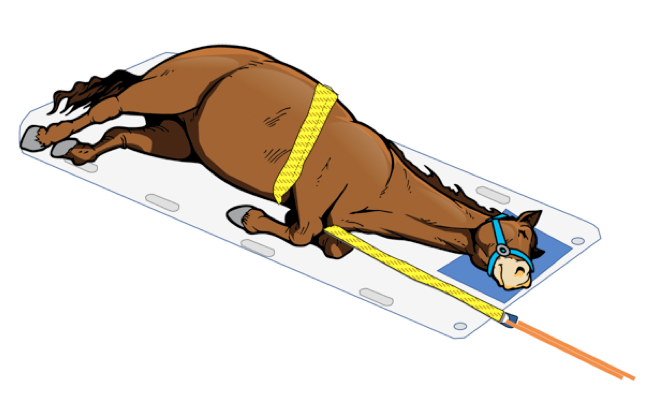
| Rear or backwards skid | |
|---|---|
| Avoids using the animal's legs, tail or head for traction and can be used to manoeuvre animals through narrow
gaps Applies a lot of pressure around one area of the abdomen Care needs to be taken to avoid pressure on genitalia or udders Care needs to be taken to protect the eye and body from abrasion |
Thread a 6m X 75mm sling around the animal's girth (in front of its hips) and carefully bring both sides of
the sling between the rear legs (either side of the genitals or udder) Thread a 15 - 20 m X 13mm rope through the eyes of the sling ensuring both sides of the rope are equalled Consider using a Rescue Glide or tarp to reduce friction and damage to the animal Lift the animal's head whilst skidding to protect eye |
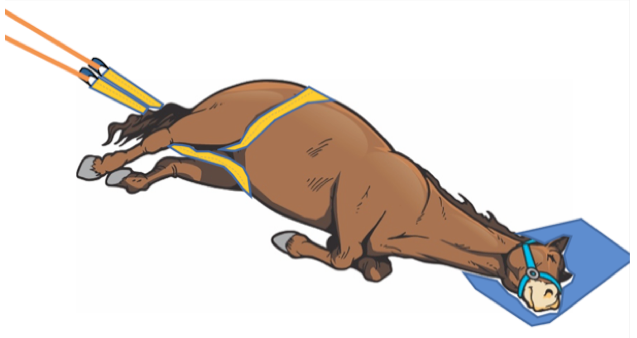
| Sideways skid | |
|---|---|
| Avoids the animal rolling (which can result in stimulation of the animal) and provides a lot of
manoeuvrability Having two points of contact minimises the pressure on the thorax and abdomen with the effort spread between two lines of emergency responders Care needs to be taken to protect the eye and body from abrasion |
Thread a 6m x 75mm-wide sling under the animal. Make sure the middle of the sling lines up with the sternum
and move the other end of the sling between the front legs and under the neck Thread another 6m x 75mm-wide sling under the animal as you would in a rear skid. Move the other end of the sling over the bottom legs and under the tail Thread two separate 15 - 20m x 13mm ropes through the eyes of the two slings ensuring both sides of the rope are equalled Consider using a Rescue Glide or tarp to reduce friction and damage to the animal Lift the animal's head whilst skidding to protect eye |
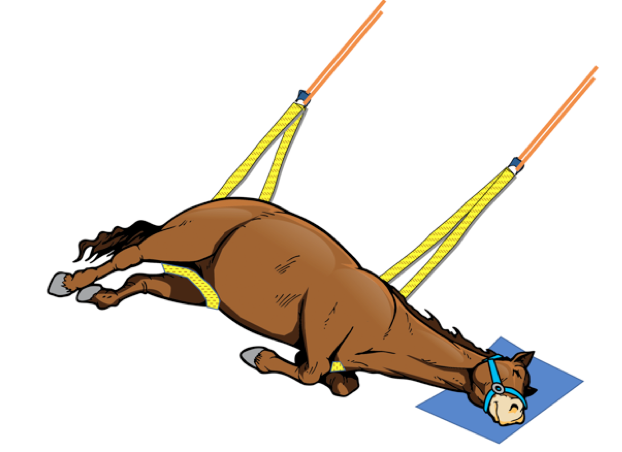
| Barrel skid | |
|---|---|
| Can be used to raise a standing animal where steep sides prevent a sideways skid, e.g. farm dam or
swimming pool Can be applied from one side of the animal if required Care needs to be taken to protect the eye and body from abrasion |
Thread two 6 m x 75mm slings under the animal and position them just behind the front legs and just in front
of the back legs Thread a separate 15 - 20 m x 13mm rope through the eyes of the two slings ensuring both sides of the rope are equalled Consider using a Rescue Glide or tarp to reduce friction and damage to the animal |
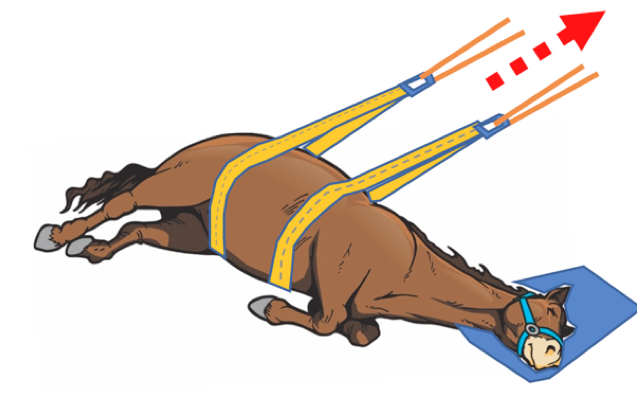
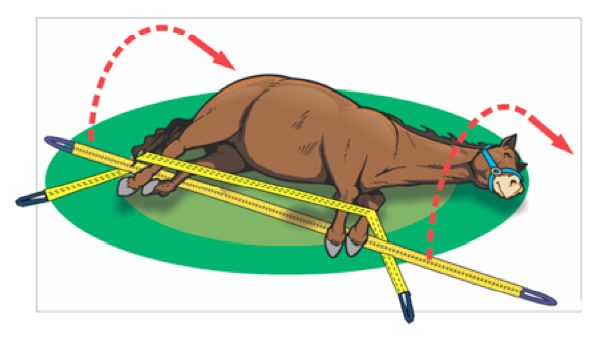
| Rollover or controlled rollover | |
|---|---|
| An animal that has been laying on its side for a long period may need to be rolled over before it can stand;
or if the animal's legs are up hill; or the animal is cast in its yard Can be carried out on most sizes of animal with a minimum number of personnel |
Thread a 6 m x 75mm sling under the horse's legs (pastern) Thread another 6m x 75mm-wide sling over the first sling to hold it in place as you roll the horse Four persons pull the slings using a lifting and sweeping motion roll to the horse over |
| Lift and skid | |
|---|---|
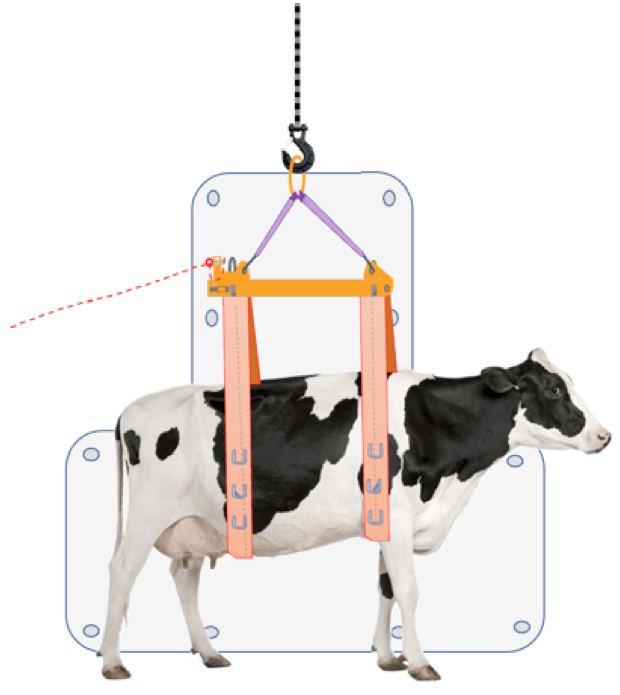
| There are situations where a cow may need to be lifted and skidded in one movement, typically up and over a
steep river or creek bank; or up and over the steep side of a farm dam The steepness of the terrain and weight of the animal is often too much of a load for a hand hauling team A vehicle-mounted winch may be required |
Rig the cow with two (2) x 150mm (Hampshire) slings into the Eburn bar quick release bar connected to the
vehicle-mounted winch You may need a short strop guide to help rig the slings beneath the animal Connect the safety release cord into the Eburn bar Lay one Glide sheet horizontally between the animal and the bank. Lay a second Glide sheet vertically beneath the first Glide sheet This arrangement will allow the horizontal glide sheet to slide up and over the vertical glide sheet |
Tips for veterinarians
75mm flat slings are cheap and can be purchased from hardware stores or 4WD shops. I like soft 75mm tree trunk protectors. Fencing wire can be cut and folded a couple of times and twisted together to form a simple guide to pull the sling beneath the animal.
You can call 000 and request help if a domestic animal needs rescuing. The Police rescue co-ordinator will task your request to the local General Land Rescue unit.
Not all NSW General Land Rescue units are trained in Large Animal Rescue Operations.
Discuss with your rescuers the most appropriate and humane technique for moving or lifting the large animal.
Always have a contingency plan that can be implemented if the initial skidding or lifting plan is unachievable or the situation changes. This contingency plan may well be euthanasia.
References
- AFAC (2022) Large Animal Rescue Operations Guidelines. Retrieved from www.afac.com.au
- BARTA (2023) Large Animal Veterinary Responder Awareness www.bartacic.org
- BARTA (2023) Standard Manual Stropping Techniques www.bartacic.org