
CASE NOTES
Experiences working in a forward command post during the varroa mite biosecurity response
Megan Davies, District Veterinarian, Narrabri
Posted Flock and Herd August 2025
INTRODUCTION
In June 2022, varroa mite (Varroa destructor) was detected at the Port of Newcastle due to routine surveillance by bee biosecurity officers2. Varroa mite is the most serious pest of European Honeybees worldwide, and prior to this detection, Australia had been free of varroa mite1. An emergency response was enacted, led by NSW Department of Primary Industries (DPI), and a Biosecurity (Varroa Mite) Emergency Order3 was issued by the NSW Chief Plant Protection Officer.
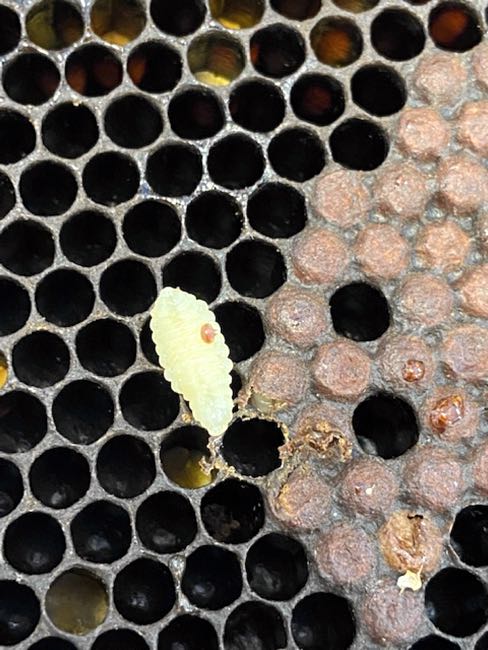
Figure 1. Varroa mite on bee larvae. Photo from NSW DPI Biosecurity Facebook page 11/7/2022
The aim of the response was to determine the extent of spread of varroa mite, destroy known infestations, prevent further spread, and allow risk-based movements. Initially, a varroa mite General Emergency Zone that included the state of NSW4 was declared.
Tracing and surveillance activities were undertaken in response to the detection.Surveillance focussed initially on the immediate geographical area around the detection, while tracing focused on hives that had been moved to and from the region. This tracing and surveillance resulted in the detection of varroa mite on a property east of Narrabri, in north-western NSW in early July 2022.
To respond to this detection, a Forward Command Post (FCP) was set up in Narrabri, staffed by Local Land Services (LLS) and DPI, with the assistance of volunteer beekeepers. This FCP operated for seven weeks.
On 19 September 2023, after more than 12 months of active response, the National Management Group confirmed that the eradication of varroa mite was no longer feasible, and the response transitioned into a management phase2.
RESPONSE STRUCTURE
A State Coordination Centre (SCC) was set up at Orange Agricultural Institute, and a Local Control Centre (LCC) was set up at Maitland, geographically close to the initial Infected Premise (IP) and the majority of subsequent IPs.
FCPs were set up where field activities were being undertaken some distance from the LCC and SCC. Narrabri Forward Command Post (FCP2) was the second to be set up during this response. Additional FCPs were established at Grafton (in response to a local detection of varroa mite), Griffith and Balranald (to facilitate movement of hives for time-critical pollination of crops).
FORWARD COMMAND POST STRUCTURE AND PURPOSE
The FCP set up at Narrabri had the purpose of providing a local base for field crews conducting surveillance and eradication activities. It was set up in the Narrabri LLS boardroom, which had recently been resourced for use as a control centre during responses.
The FCP was led by an Officer In Charge (OIC), with a logistics support officer, a field team leader and field crews, the number of which varied throughout the seven weeks the FCP was operational. The field crews included Authorised Officers under the NSW Biosecurity Act 2015 to enforce the biosecurity directions under which the field crews were operating. The OIC reported directly to the State Operations Officer at the SCC.
Following the detection of the IP near Narrabri, biosecurity zones were declared around the property. A Red Eradication Zone with a 10km radius around the IP, a Purple Surveillance Zone with a 25km radius around the IP, and a Yellow Notification Zone with a 50km radius around the IP were established and publicised (see figure 2). The state of NSW was declared a General Emergency Zone. The notification zone was removed as the response progressed.
Bee owners were encouraged to report the location of their hives. Reports of both wild and managed hives were also received from members of the public, and hives were also identified from LLS apiary records and local knowledge from other government agencies. These notifications formed the basis of surveillance activities.
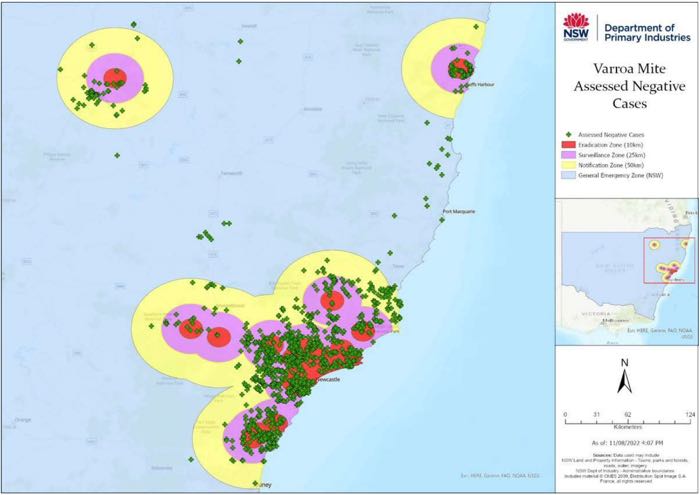
Figure 2. Map showing the coloured eradication, surveillance and notification zones, as well as varroa mite assessed negative cases as of 11 August 2022. Image from NSW DPI Biosecurity Facebook page 18/8/22.
SURVEILLANCE
The response staff working from the FCP were tasked with conducting surveillance of all known hives in the eradication and surveillance zones. This surveillance was later expanded to include all hives in the notification zone, and several local properties that required surveillance due to tracing from other IPs around the state.
The first round of surveillance involved conducting alcohol washes on hives. This process requires the hive to be opened and a sample of bees collected in a jar, which then has alcohol (ethanol) added. The jar is then shaken to dislodge any mites that might be on the bees and visually inspected for the presence of mites. Any suspect mites were sent to Orange Agricultural Institute for confirmation of identification by entomologists.
The second round of surveillance involved placing sticky mats into the bottom of hives, along with miticide-impregnated plastic strips, to kill mites and collect them as they fell onto the sticky mats. This process also required the hives to be opened, frames removed, and sticky mats placed. The mats were then collected 3-5 days later and sent to Orange for examination by entomologists.
The purpose of this field work was to detect any mites that may have spread from the initial IPs and determine whether other hives within the biosecurity zones were infected.
Field crews were also tasked with the destruction of hives on the IPs and within the eradication zone, which included euthanasia of bees, burning of frames, and wrapping hives in plastic wrap.
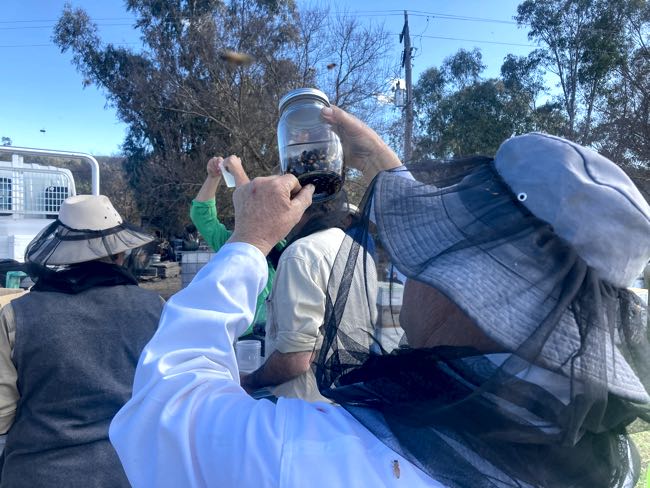
Figure SEQ Figure 3. Response staff conducting an alcohol wash on a sample of bees. This method was used for the first round of surveillance.
LESSONS LEARNED FROM THE FCP
Communication
As with any major response, the initial days to weeks were very busy, as structures were put into place, staff were recruited, and strategies were established. It was during these early days of the response that the Narrabri detection occurred. To limit the spread of the mite as quickly and effectively as possible, new detections were publicly announced as soon as possible after the detection was confirmed.
These public announcements meant that new cases were posted on social media, often before local staff could be notified by the response. As a result, staff in the northwest began receiving enquiries about the response from the public before they were aware of cases in their area.
The key lesson from this response from a local point of view is that communication with on-ground staff in local areas is essential for both the efficient set up and coordination of a response, and for managing the influx of local enquiry and emotion that accompanies landholders impacted by biosecurity responses.
Specialised knowledge
It was quickly recognised during this response that there were very few staff in the greater northwest area with any knowledge of, or experience with, bees. It also became apparent throughout the response that there were several staff with (known or unknown) allergies to bee stings.
The lack of staff trained in beekeeping both locally and across the state led to difficulties filling the rosters for field work. Specialist beekeeping staff from DPI needed to be brought in from elsewhere and those with these skills were in high demand across all response operational areas. Volunteer beekeepers were sought to fill the gaps, but these were also in short supply.
It was also an issue from a work health and safety point of view, with untrained staff with little experience with bees heading out for long days in the field, dismantling hives, and working with bees who were often infrequently handled. This circumstance resulted in many staff being stung by bees and several allergic reactions.
Solving the problem of a lack of specialist animal handlers is not an easy thing to do. When planning for responses affecting other species, the acquisition or rapid training of people to fill these roles needs to be considered.
Use of volunteers
Volunteer beekeepers were requested to assist with surveillance of hives during the response. These beekeepers came from across the state and generally worked on the response for several days at a time. At a local level, these beekeepers were invaluable as they provided a trusted source of knowledge for local beekeepers to contact and assisted response staff with accessing hives across the region. They also proved invaluable in training staff in how to handle hives, minimise the risk of stings, and minimise harm to the bees themselves.
Given their value to the response, it was important that the response support these volunteers and minimise the expenses and inconvenience they incurred.
In future responses when volunteers are used, their expenses should be paid for up front whenever possible. They should also be thanked regularly and profusely by all levels of the response, with consideration given to other means of recognition for their efforts.
Premise location and tracability
For some species there are systems for identifying animals, their location, and/or their movements, for example the National Livestock identification System, electronic ear tags, microchips, and council registration systems for companion animals. Unfortunately, there is no such comprehensive system for the registration of beehives, both commercial and recreational, and no way of monitoring feral or wild hives.
The result of this lack of recording system was that we were reliant upon beekeepers to self-report their hives. This method clearly provides incomplete data, and there was no way to ensure we had conducted surveillance on all hives in an area. In the Narrabri area, when all known hives were mapped, there were large geographical areas with no reported hives. These were inspected in person where possible, but gaps remained.
When planning for future outbreaks in any species, the ability to identify and communicate with all potentially affected premises is critical to the success of a response.
Delays and being at the pointy end of a response
With any major biosecurity response, strategic decisions need to be made that happen at a high level. These decisions then need to filter down through the control centres and be converted into procedures or guides, which are then enacted by field staff.
The downside of having only one IP in the Narrabri area, and a relatively small number of cases requiring surveillance, was that we reached the “what next?” phase of the response before the rest of the state, and before the next stage of plans had been developed.
This situation is likely unavoidable in many responses. However, when preparing for potential outbreaks, having as many plans and procedures prepared in advance as possible will greatly increase the efficiency of the response and minimise staff down time.
Small towns and the bush telegraph
Those who live and work in small towns will know that usually your neighbours know your news even before you do. This tenet also applies during biosecurity responses. Efforts to maintain confidentiality of affected landholders were often futile, particularly when maps of biosecurity zones make it very simple for locals to figure out the likely point of origin of a response. All the latest response news could be heard around the bar at the pub or at footy training, despite our best efforts to keep things quiet.
This reality can also have effects on local staff working in the response as it is generally well known in town who works for the government and who is involved in responses. Staff and their families may experience unwanted questioning about the response or criticism of how things are being managed.
It is hard to manage this locally, but when sensitive tasks need to be undertaken, such as euthanasia or compliance investigations, non-local staff should be used wherever possible.
SUMMARY
The varroa mite response presented a new challenge to all staff working in the FCP in Narrabri. Overall, for most staff it was a positive experience, and several lessons were learned over the course of the response.
Communication with local staff about cases or response activities happening in their area benefits the efficacy of the response and information flow to local landholders.
Planning for the need for specialist handlers for outbreaks affecting certain species and for procedures and guides for field crews for biosecurity outbreaks will all help with the effectiveness of response operations.
Managing volunteers to ensure their response experiences are positive ensures they are more likely to return and assist again in future. The same is true for LLS and DPI staff. Managing the impact of responses on staff in smaller communities is also critical to protecting and valuing local staff and knowledge.
We hope to use these lessons to improve the effectiveness of future responses, making them more manageable for staff at all levels of response operations.
ACKNOWLEDGEMENTS
The author acknowledges the significant efforts of staff and volunteers from many agencies and organisations that contributed to the varroa mite response. Their efforts that involved working in the unfamiliar environment of a plant biosecurity response were invaluable and will contribute to the ongoing protection of Australia’s bee industries.
REFERENCES
- Somerville, Doug and Kratz, Madelyn (2022) NSW DPI Primefact - Varroa Mites s.l.: NSW Government Department of Primary Industries
- NSW Government Department of Primary Industries (2022) Varroa Mite Emergency Response. Department of Primary Industries[Online] [Cited: December 20, 2022] www.dpi.nsw.gov.au
- New South wales Government Gazette (2022) Biosecurity (Varroa Mite) Emergency Order 2022 (No.32) NSW Government Gazette No 588 of 19 December 2022 s.l.: Government Printer, 2022. Vol. Number 522, No.32. ISSN 2201-7534
- Australian Fire and Emergency Service Authorities Council (AFC Ltd.) (2017) The Australasian Inter-Service Incident Management System - A Management system for any emergency East Melbourne: AFAC Ltd.,
- Australian Government Department of Agriculture, Fisheries and Forestry (2023) Varroa Destructor - 19 September 2023 Communique www.agriculture.gov.au Accessed 30/5/2024